Snakes and Sanctuaries: The Remains of the Tide
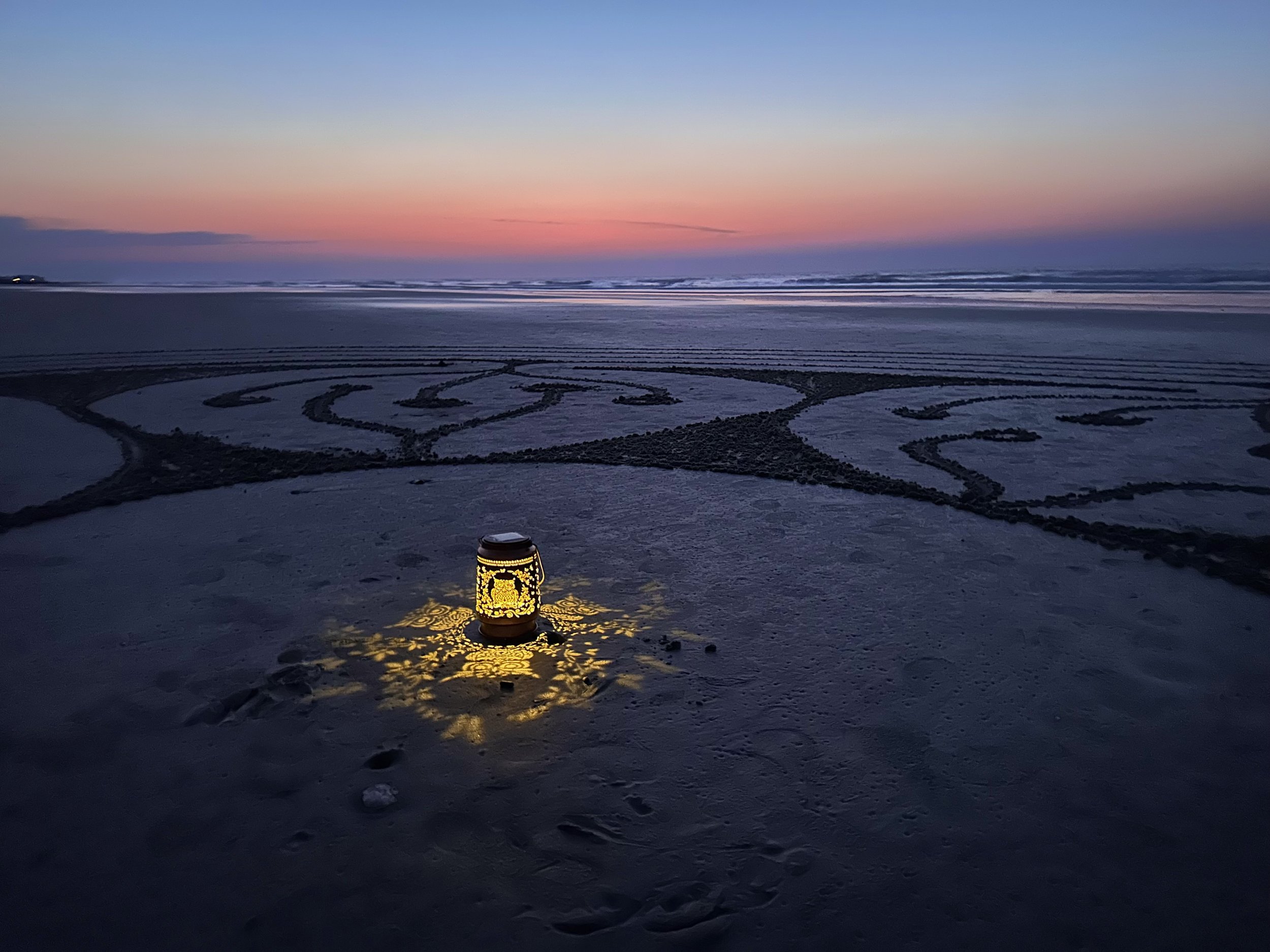
Evelyn and I set our alarms for 4:00 AM to catch low tide.
It’s still dark when we get down to the beach, and I misjudge my markers, beginning my labyrinth for the emotion of Overwhelm closer to the rising tide than I intend.
I’ve come to Folly Beach to build labyrinths for Evelyn for a few days before Emergence, a South Carolina burn. Overwhelm is the first of the 87 emotions and experiences in Brené Brown’s Atlas of the Heart I processed through a tight-knit Circle a few years ago. I’d challenged myself to design a labyrinth for each one, but I didn’t really know what I was doing yet.
All I have for Overwhelm are a few meager sketches of pods getting gradually denser with lines that force a walker to weave back and forth. Subsequent notes in two different pens introduce the idea of grouping these into seven petals, inspired by the center of a Medieval labyrinth like Chartres Cathedral, and encircling this with a spiral and another series of pods on the outside.
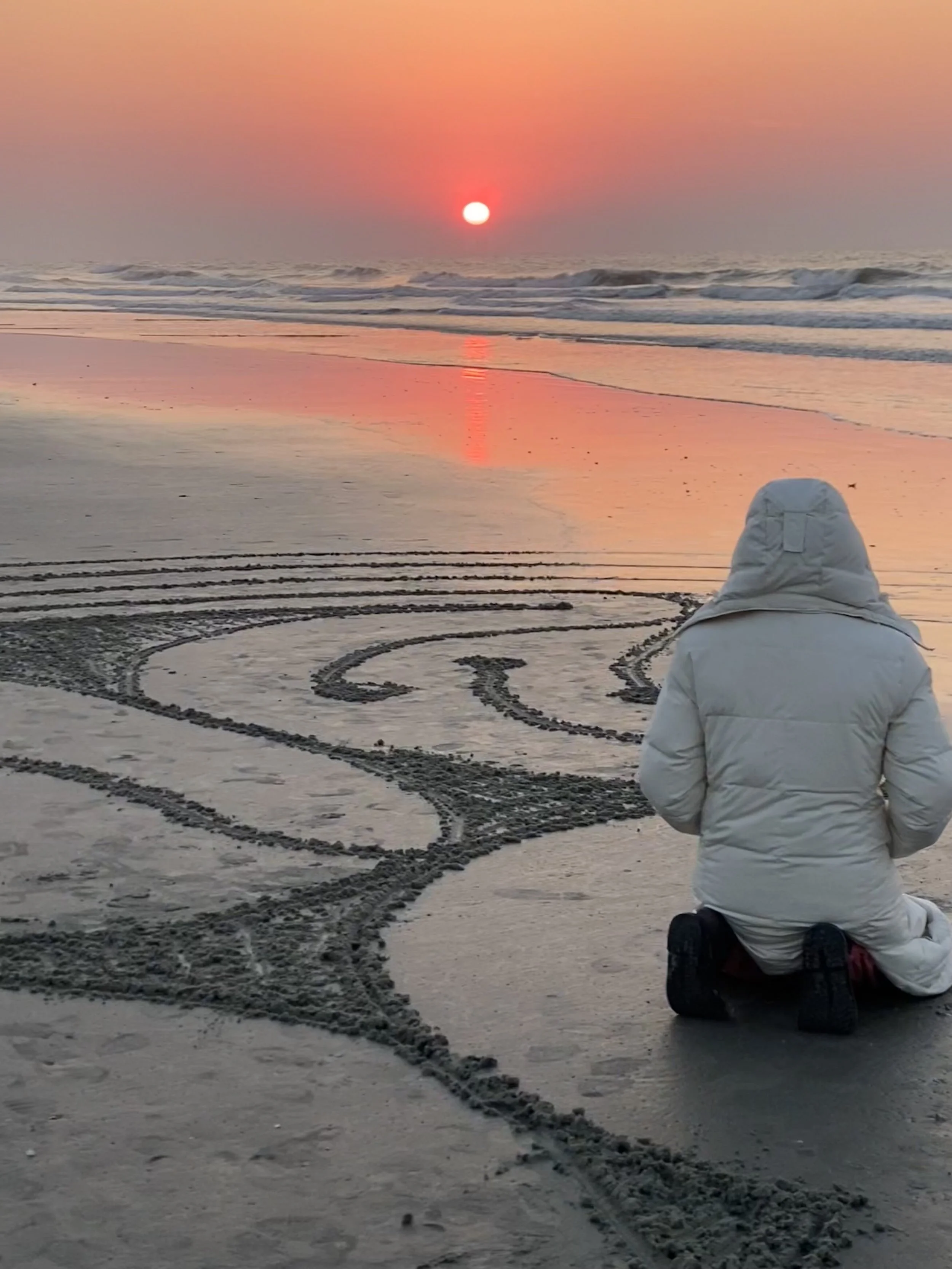
On the darkened beach, Evelyn apologizes for not being able to deepen the lines I’m sketching in the sand. Her night vision isn’t great, and though she doesn’t mention it, I know she’s still recovering from surgery. I invite her to meditate in the center of the design.
My own night vision isn’t excellent, and her white puffy coat gleams in the starlight. She is the ideal compass.
Tight on time, with the tide and the dawn rushing forward, I realize I need to improvise on the layout, so, after spiraling the center multiple times, I stretch the second set of pods up the beach, like a bumpy lollipop stick.
Walkers can enter easily, moving through the series of pods that gradually require more back-and-forth movement until the path tightens into a spiral. From there, the pattern begins to unwind, guiding them through the same number of pods in reverse—gradually reducing in complexity—until they arrive in the still center.
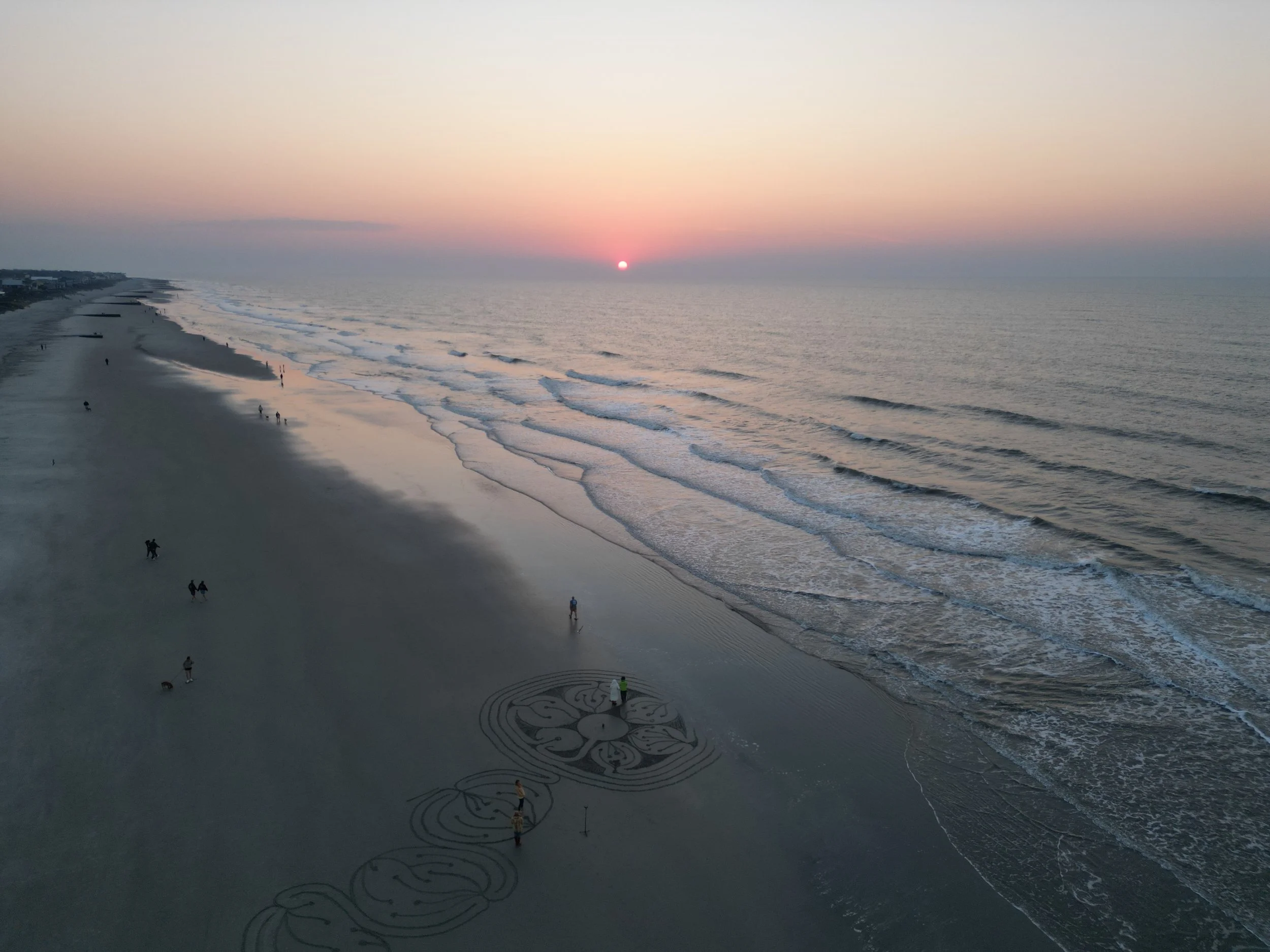
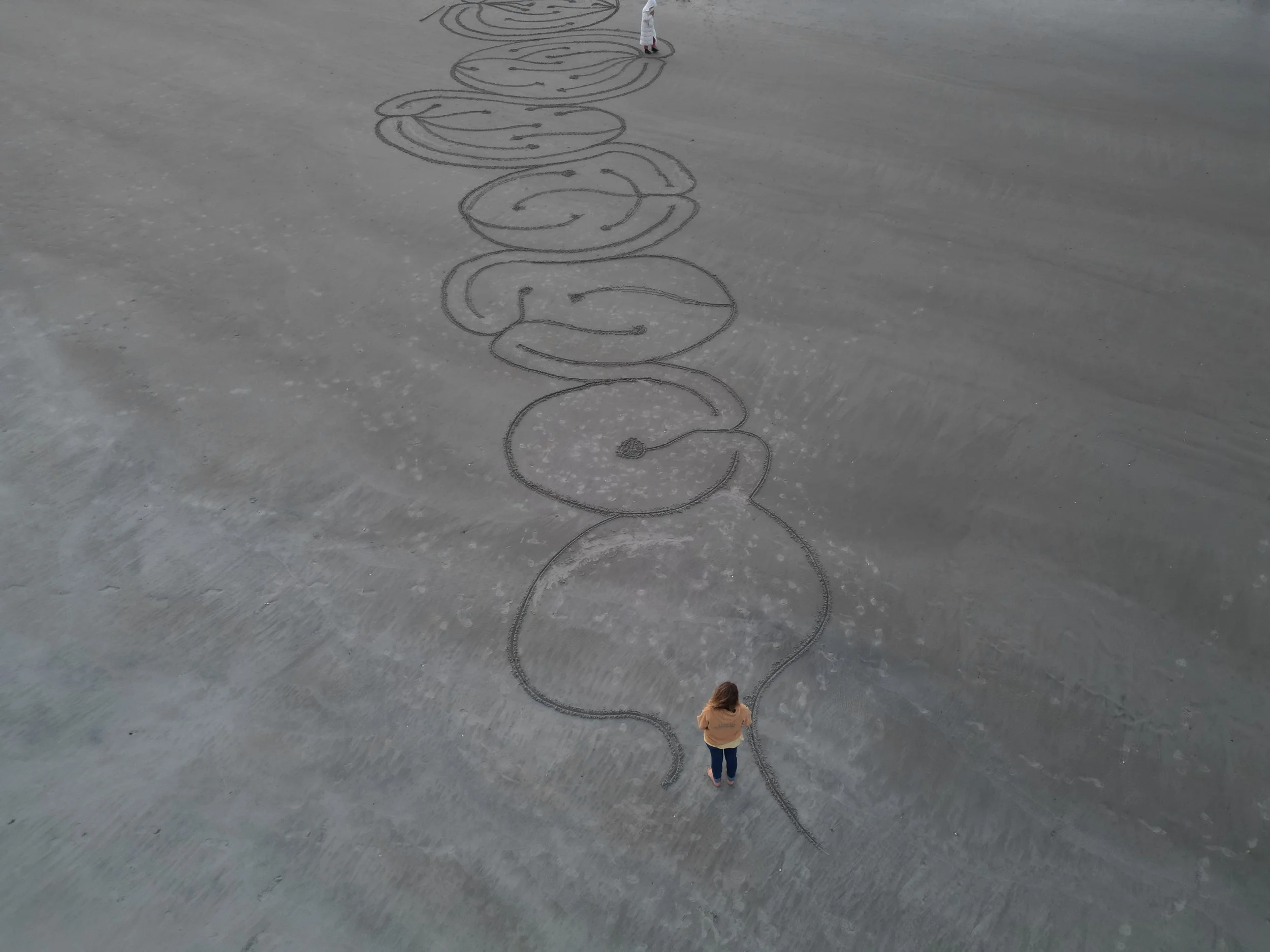
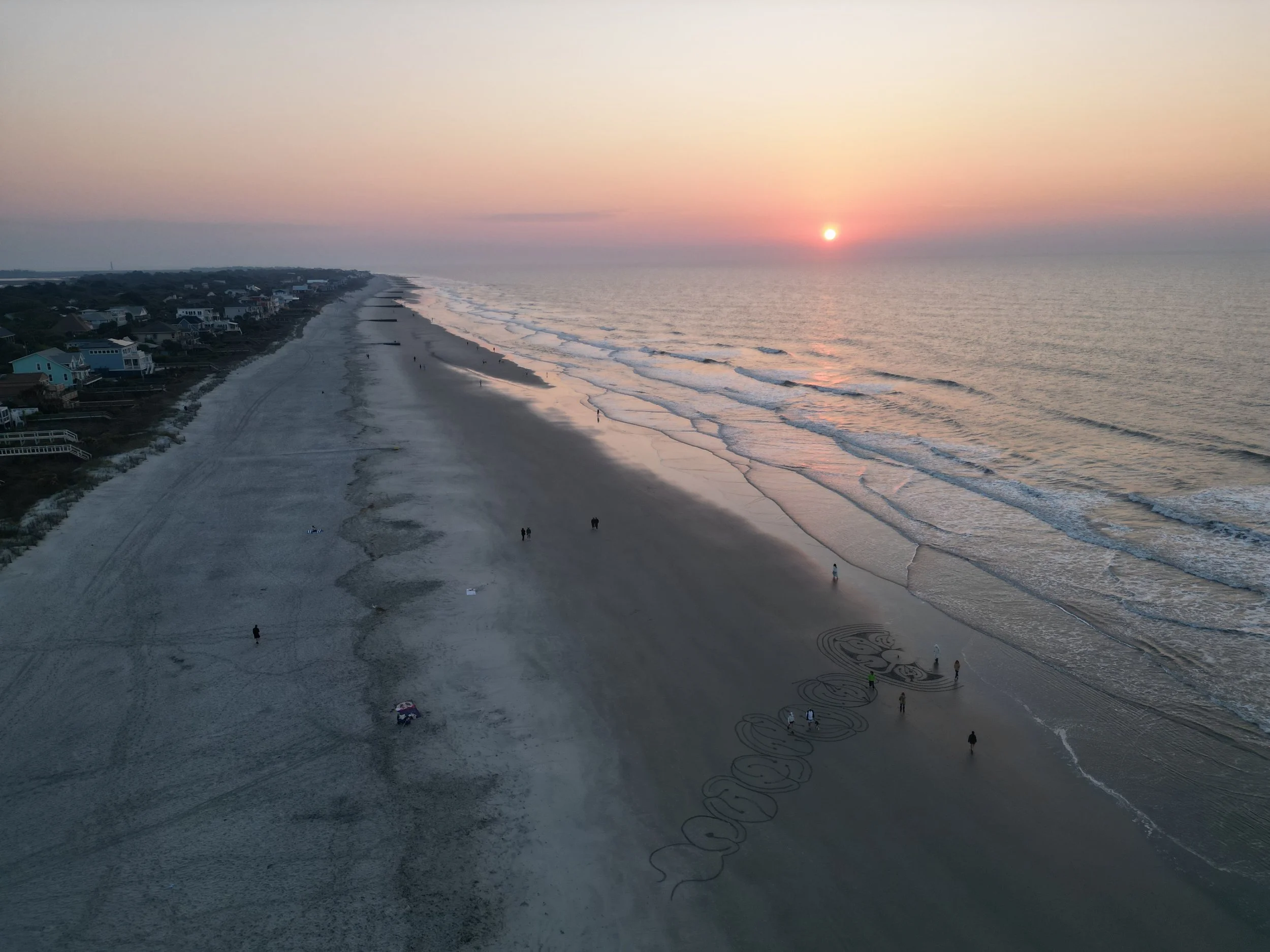
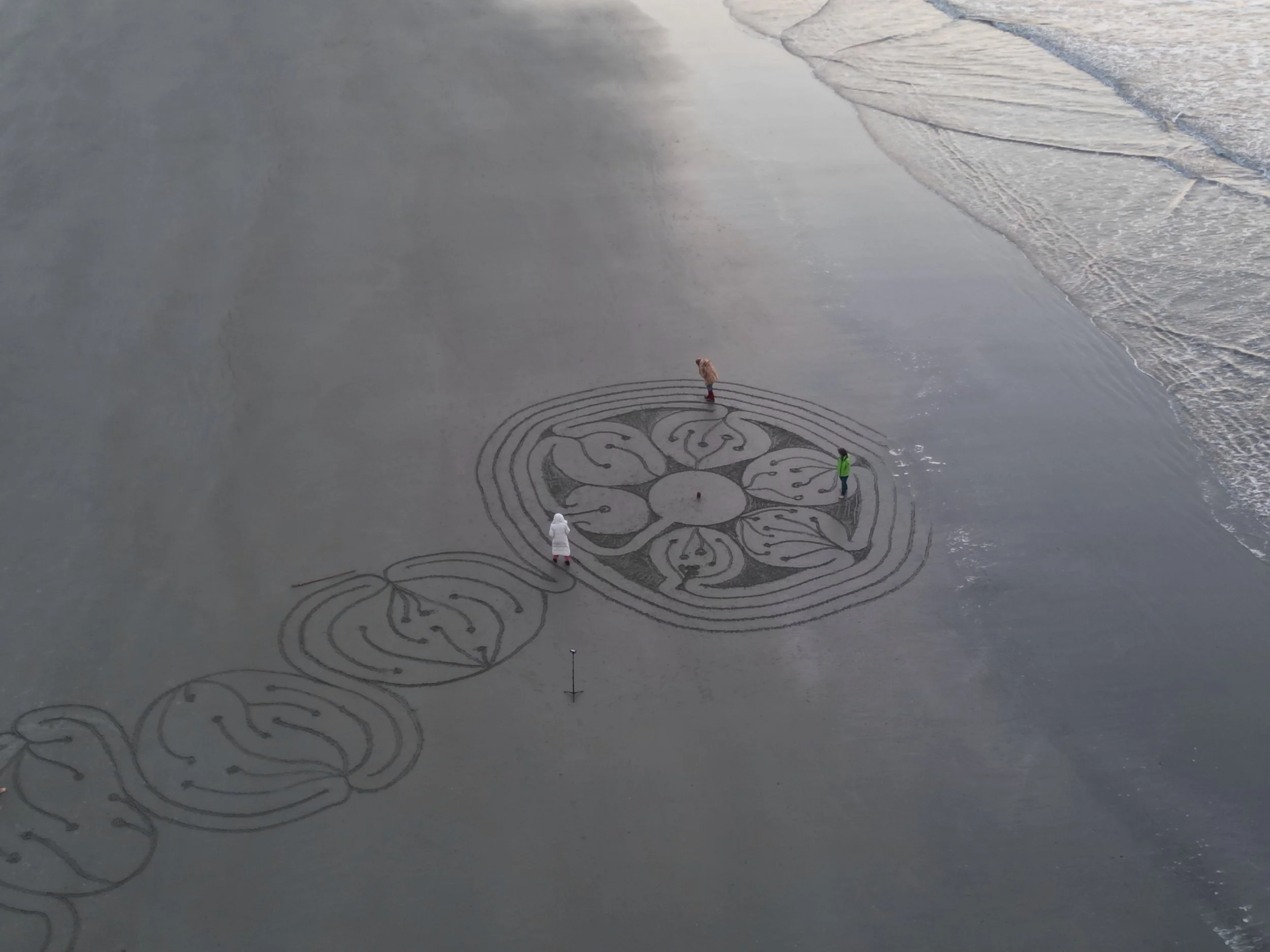
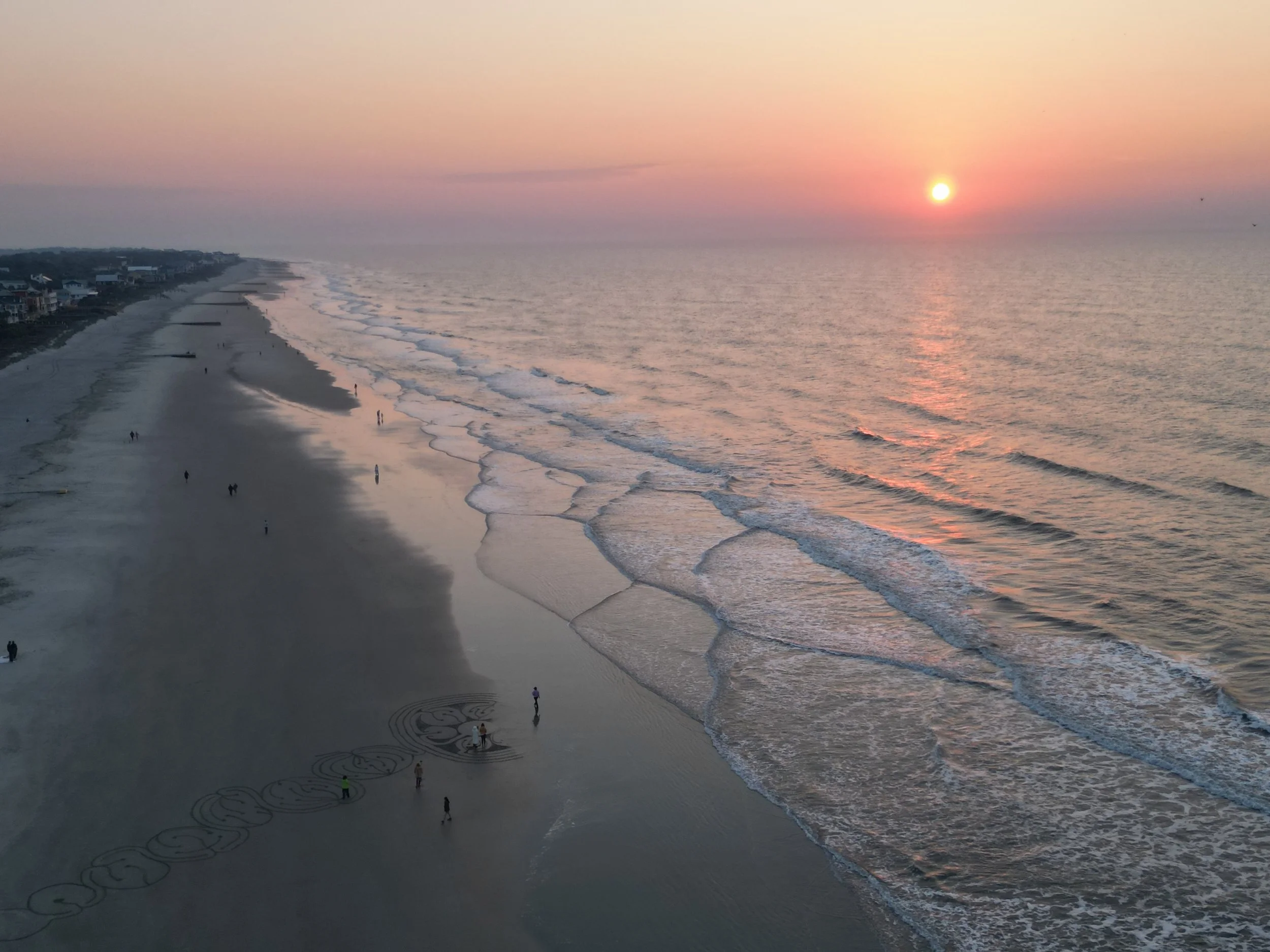
Because the physical sensations and many of the coping strategies I use are similar between the emotions of overwhelm and flooding, I crave the experience of building both on this trip, keen to understand the similarities in their differences and the differences in their similarities.
Overwhelm’s pods, these rapidly complexifying packets of information that spiral then simplify into silence, are satisfying to walk. I can feel the contraction and expansion, and Evelyn concludes she’s “overwhelmed by joy”. I know from the test build in lights of my labyrinth for flooding--the pattern I’ve dubbed Snakes and Sanctuaries--that its path is much more chaotic.
That test build went surprisingly smoothly for such a challenging emotion. Many members of Camp SandWitches showed up to help. Not only are they now familiar with how the lights are laid out and coiled away, but I gave them creative license to choose and layer colors.
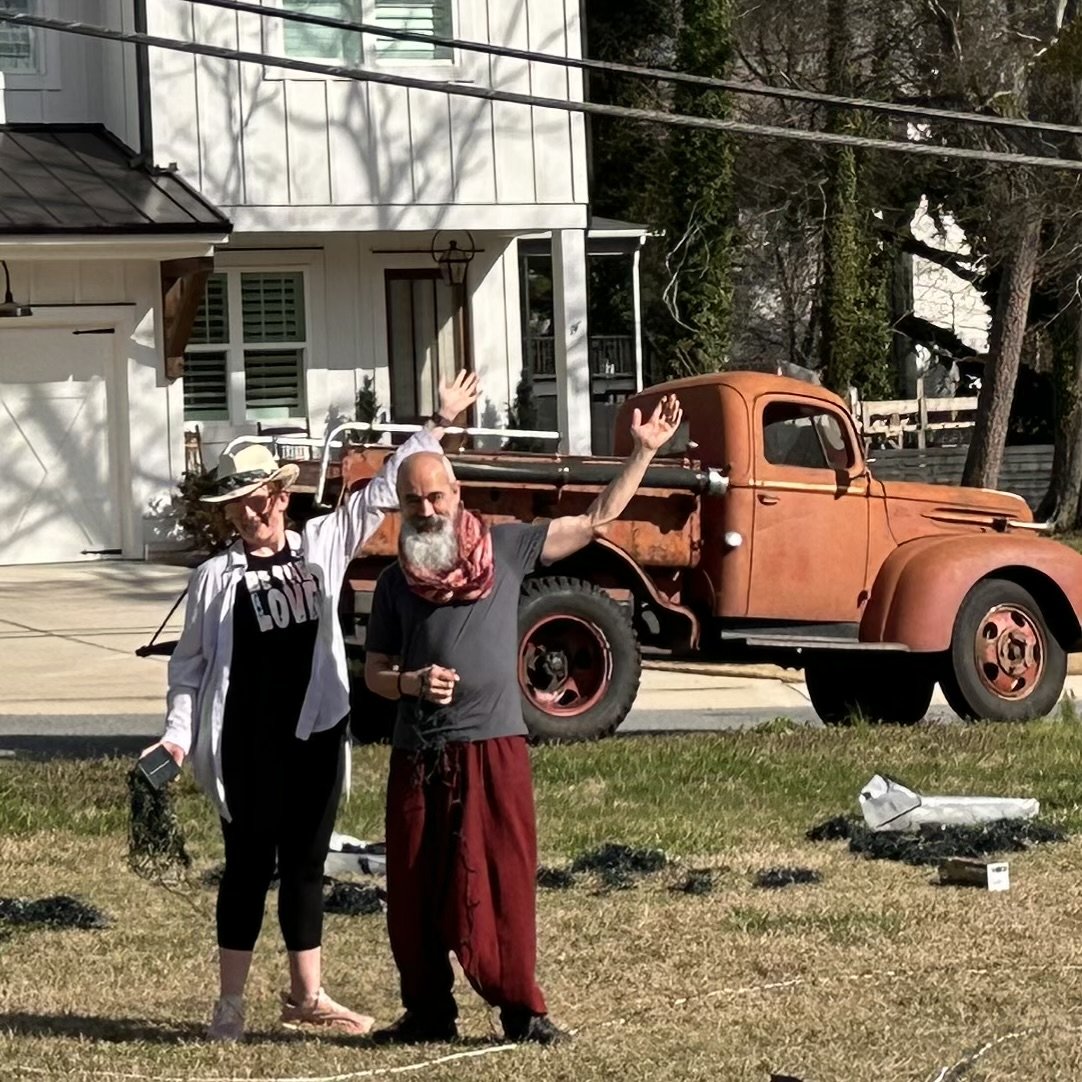
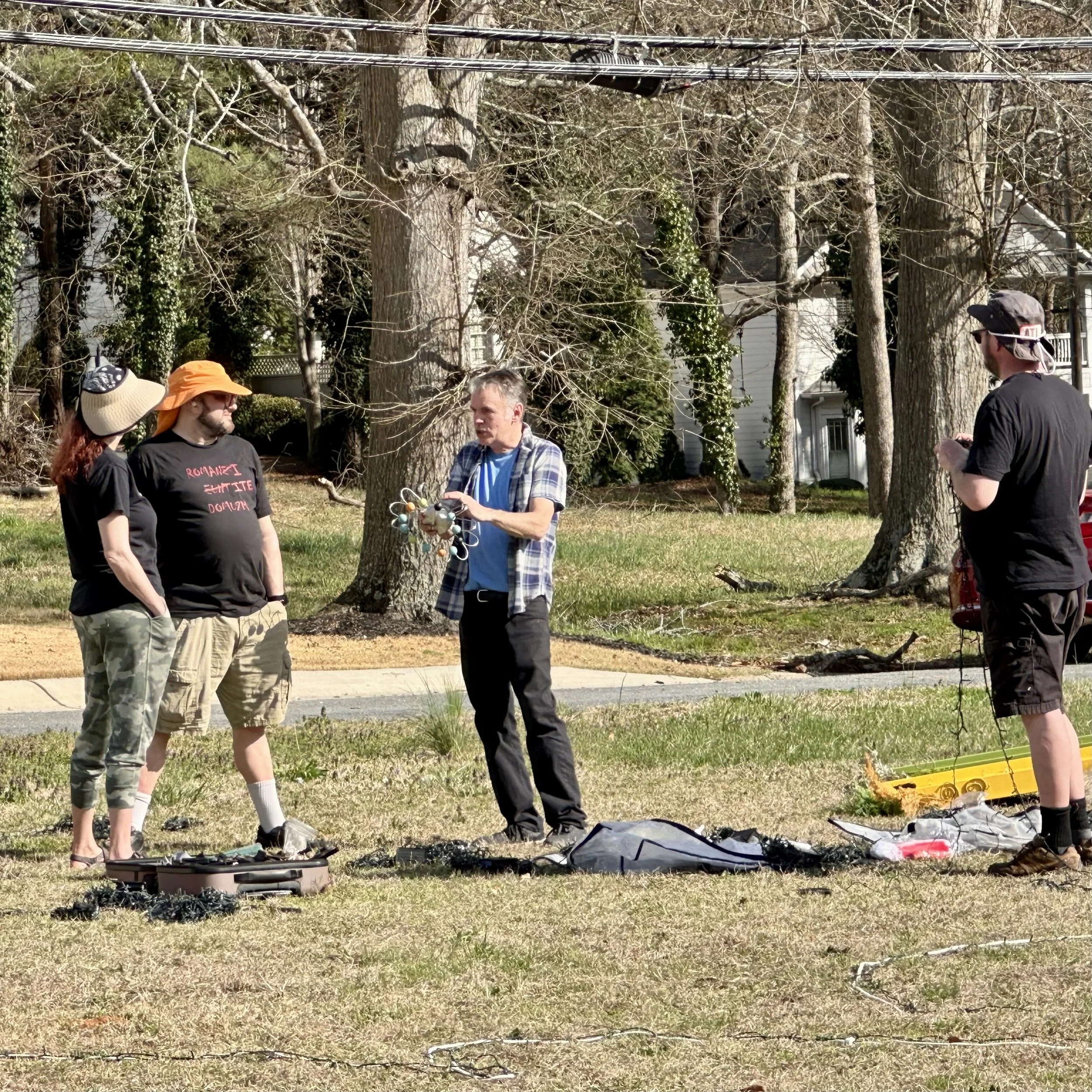
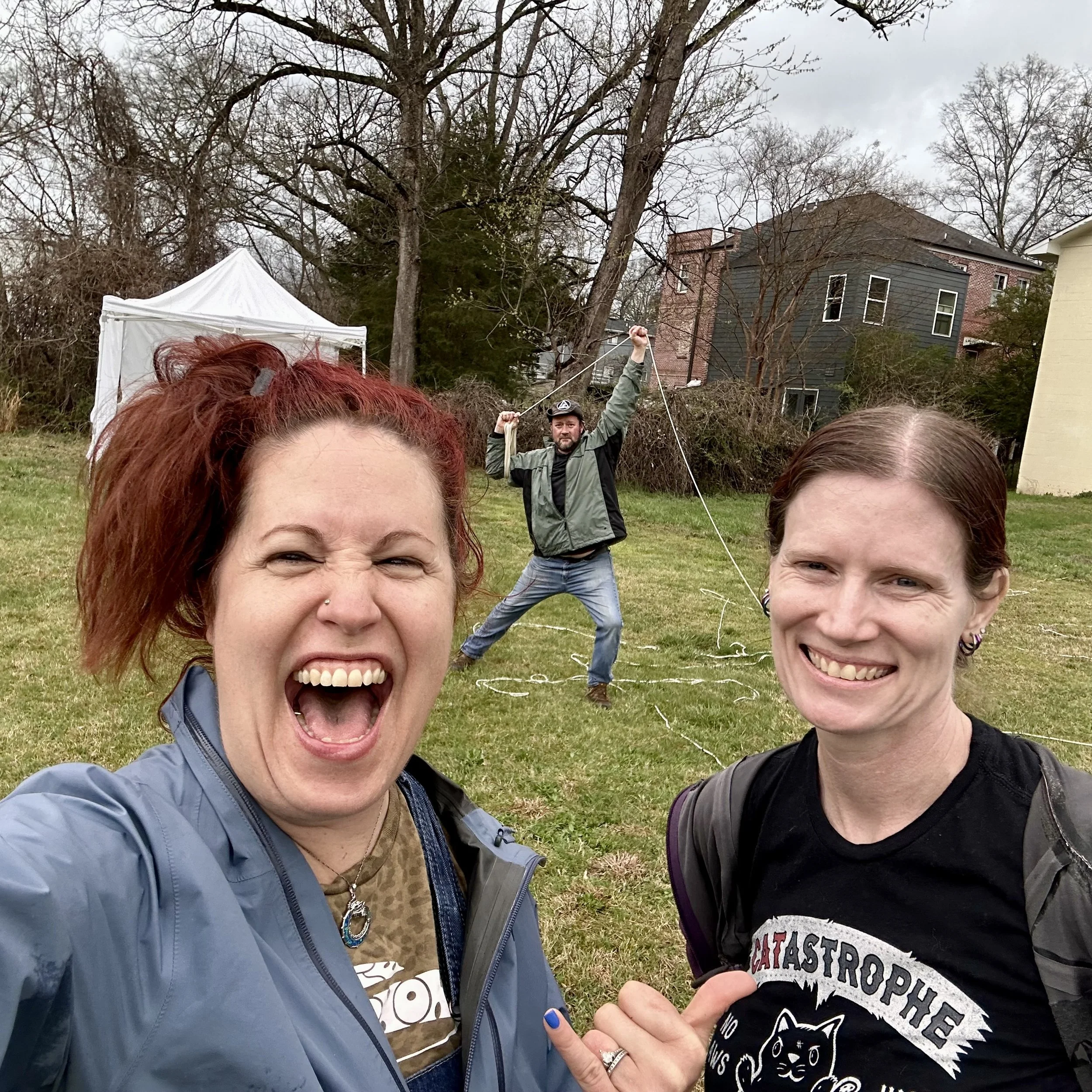
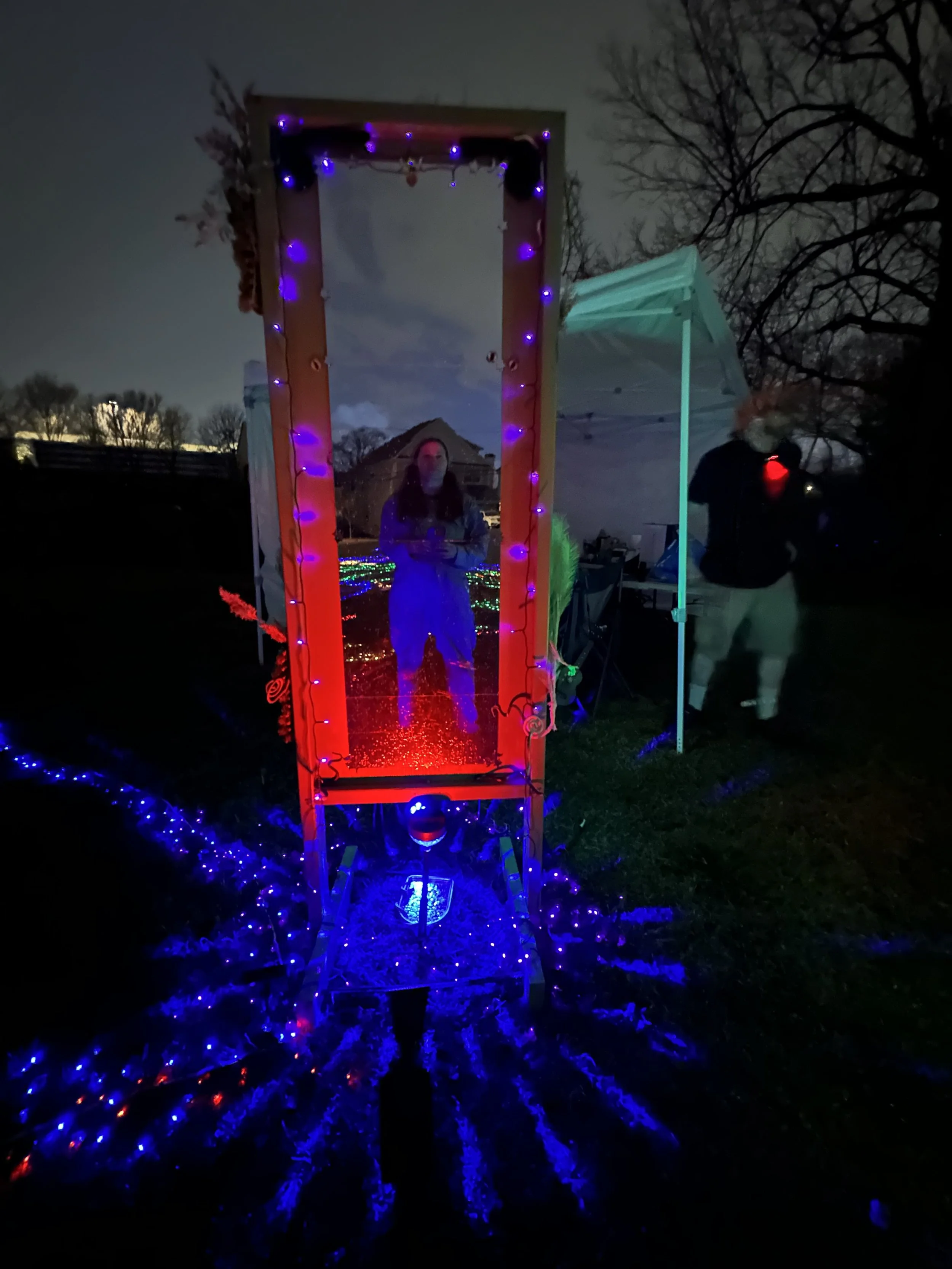
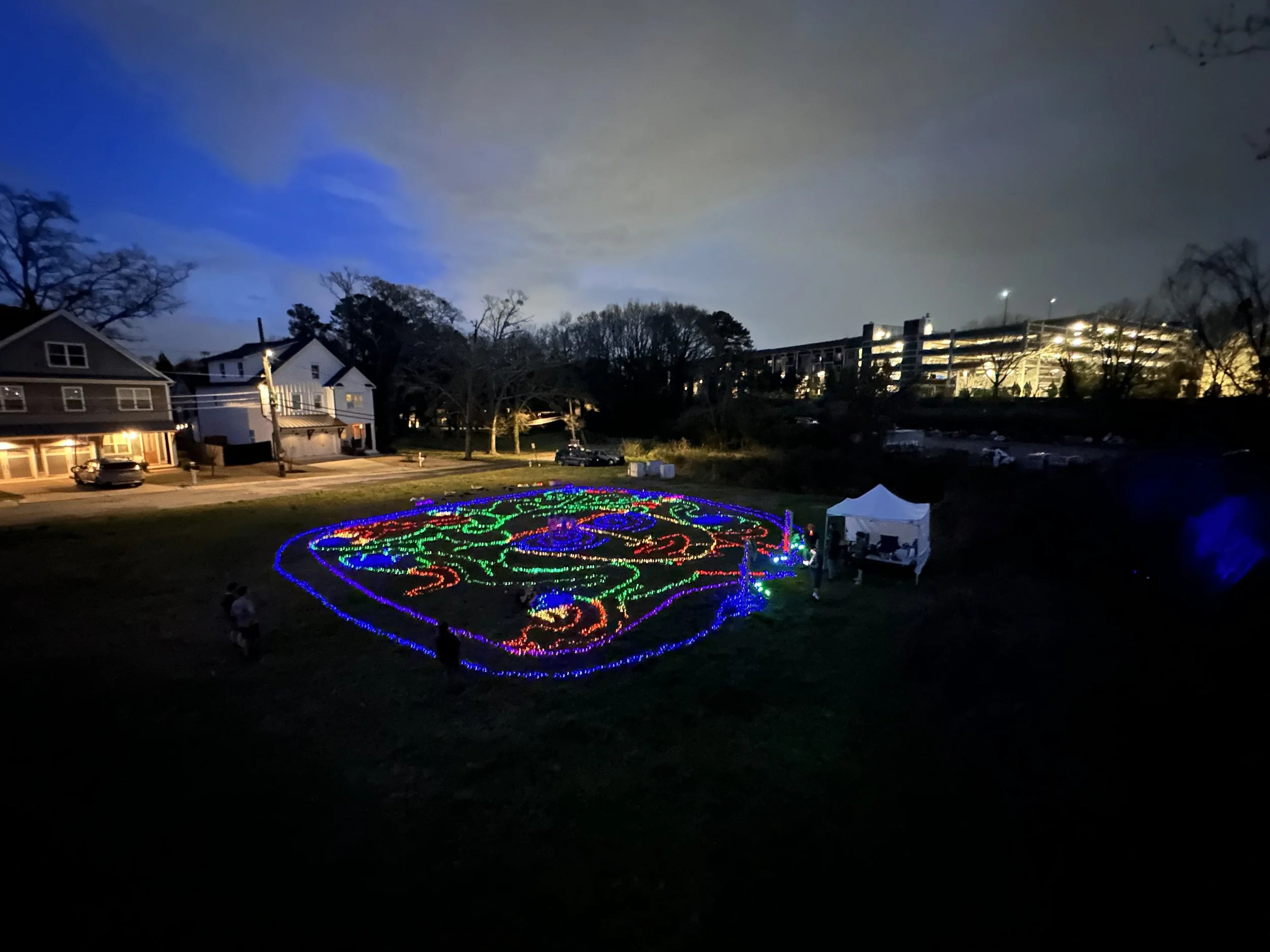
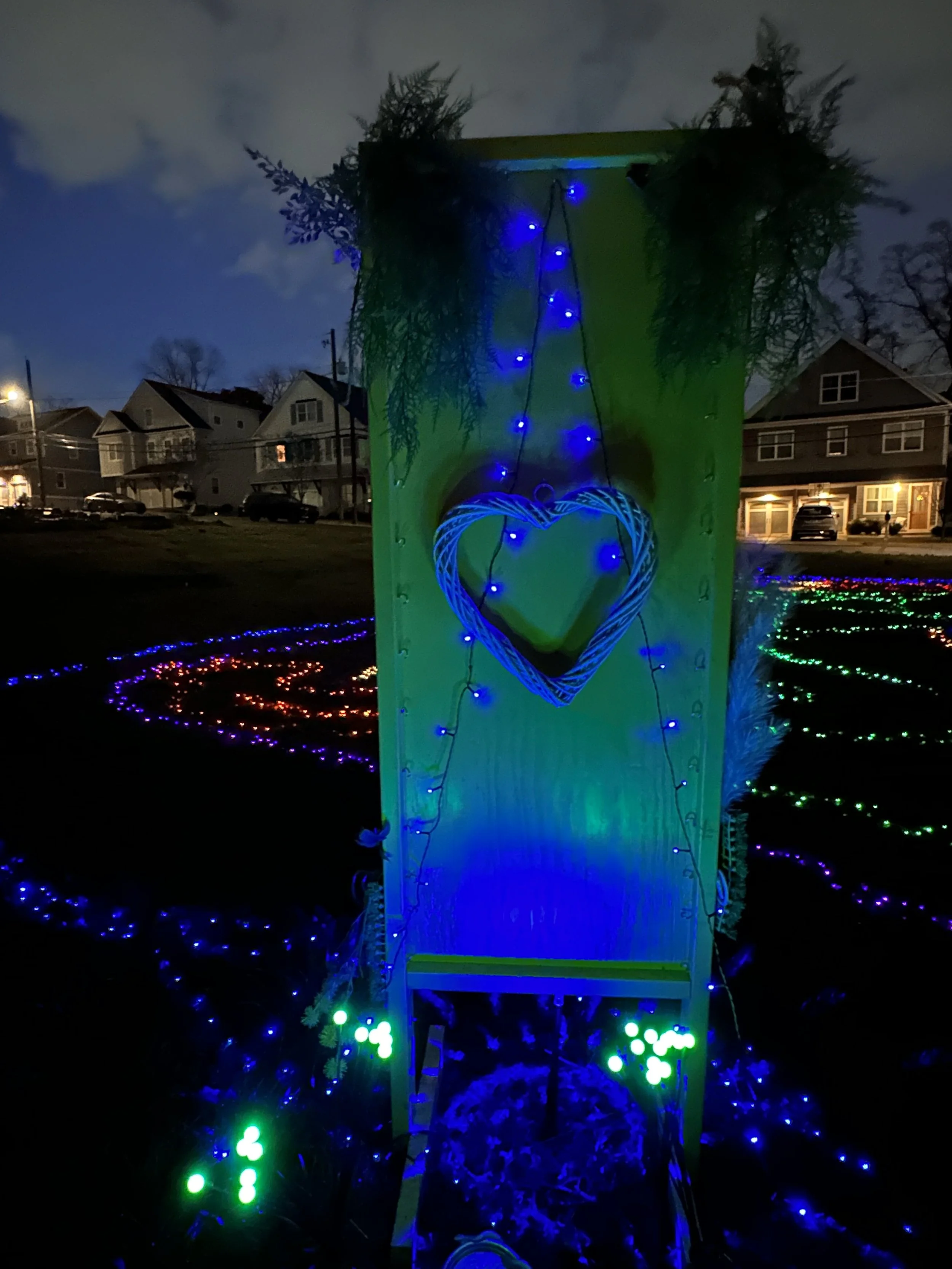
I also found myself more able to communicate things like: “This next bit’s tricky, so I’m going to get a little nonverbal. If you ask me a question, I might not understand right away, and/or I might have to explain to you what I’m doing first so I don’t lose the thread. In the meantime, these are all snakes. You know what snakes are. Just...make them look like snek!”
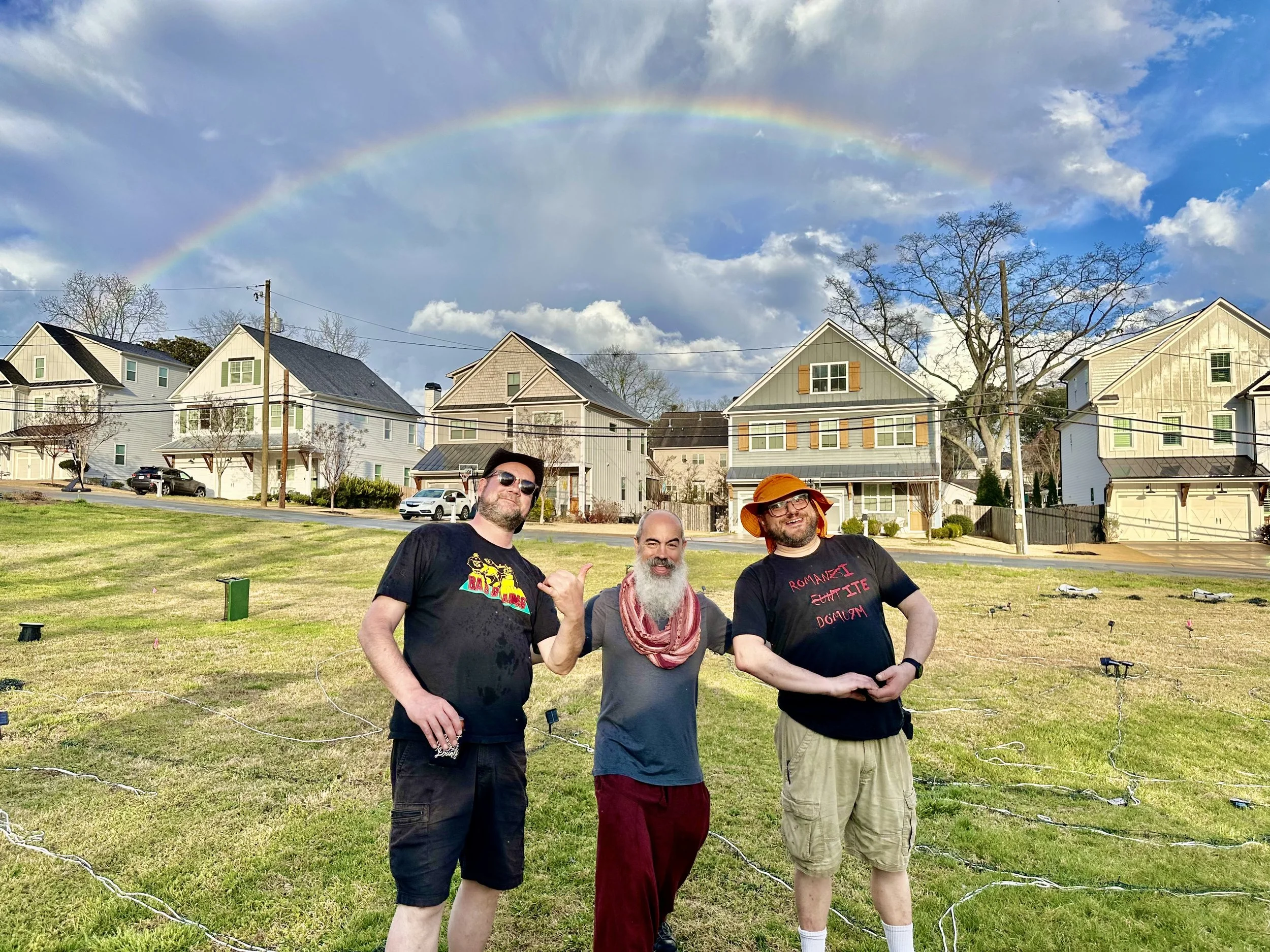
A double rainbow punctuates the beautiful energy of this test build.
After dark, a flash of lightning cuts off all the solar panels, and everyone scatters. The thunderstorm’s abrupt arrival is apt; we did build a labyrinth for flooding after all.
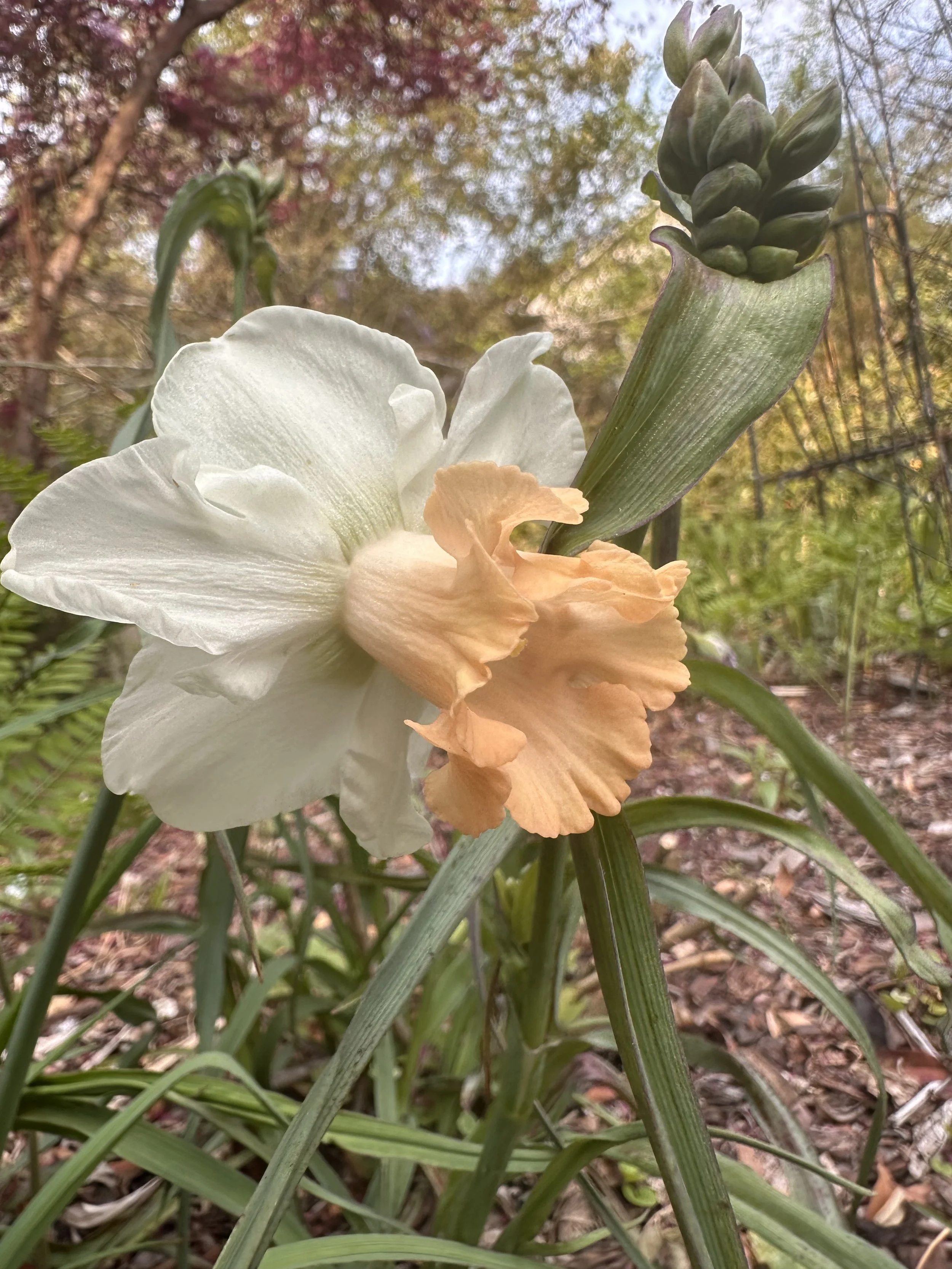
In Folly, after building Overwhelm, I enjoy a yoga class, a delicious meal, and a nap before building Relief shortly before sunset. Evelyn picked out this pattern, gravitating toward the joy of spring daffodils that signal an end to winter’s debilitating cold.
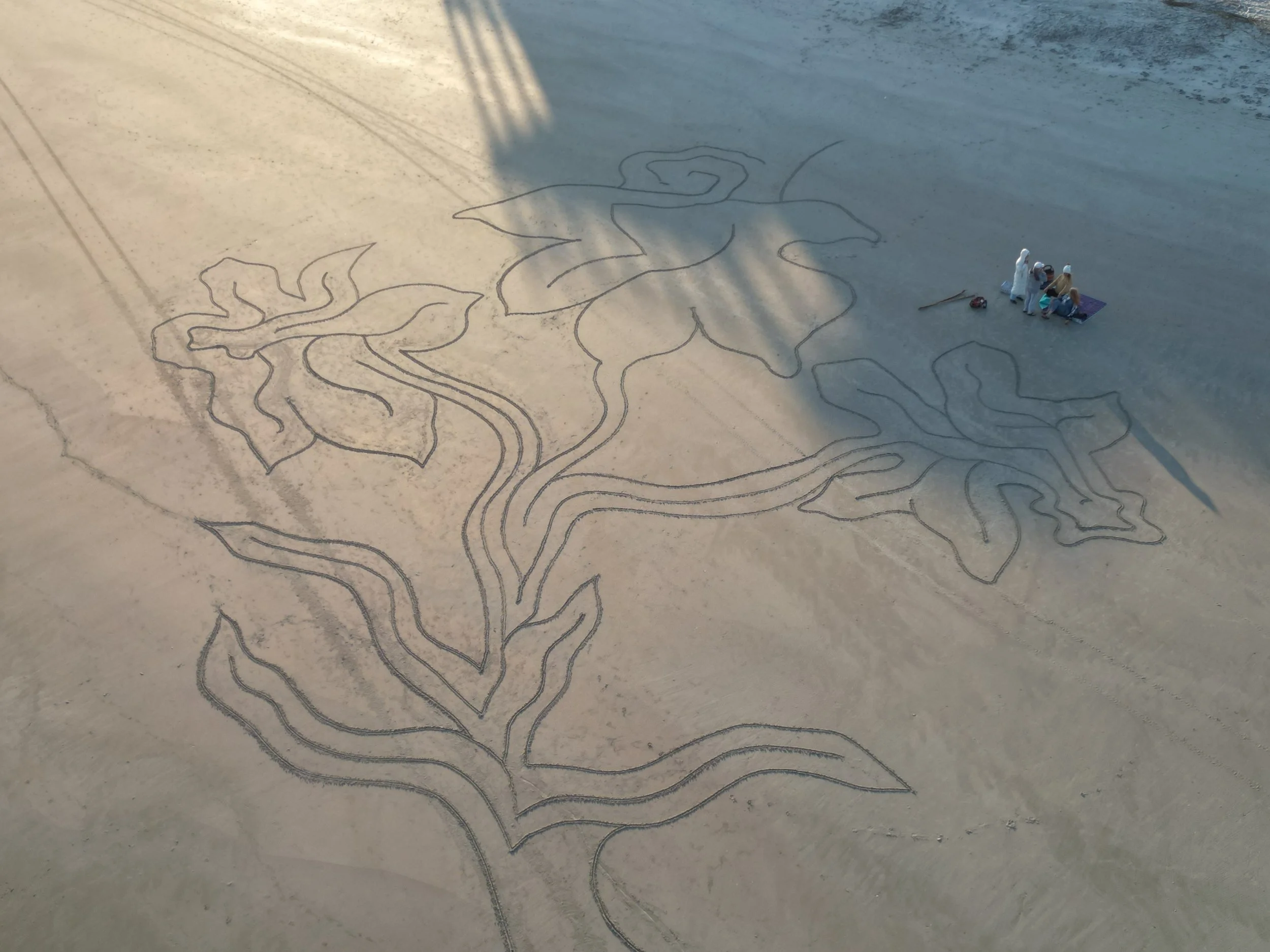
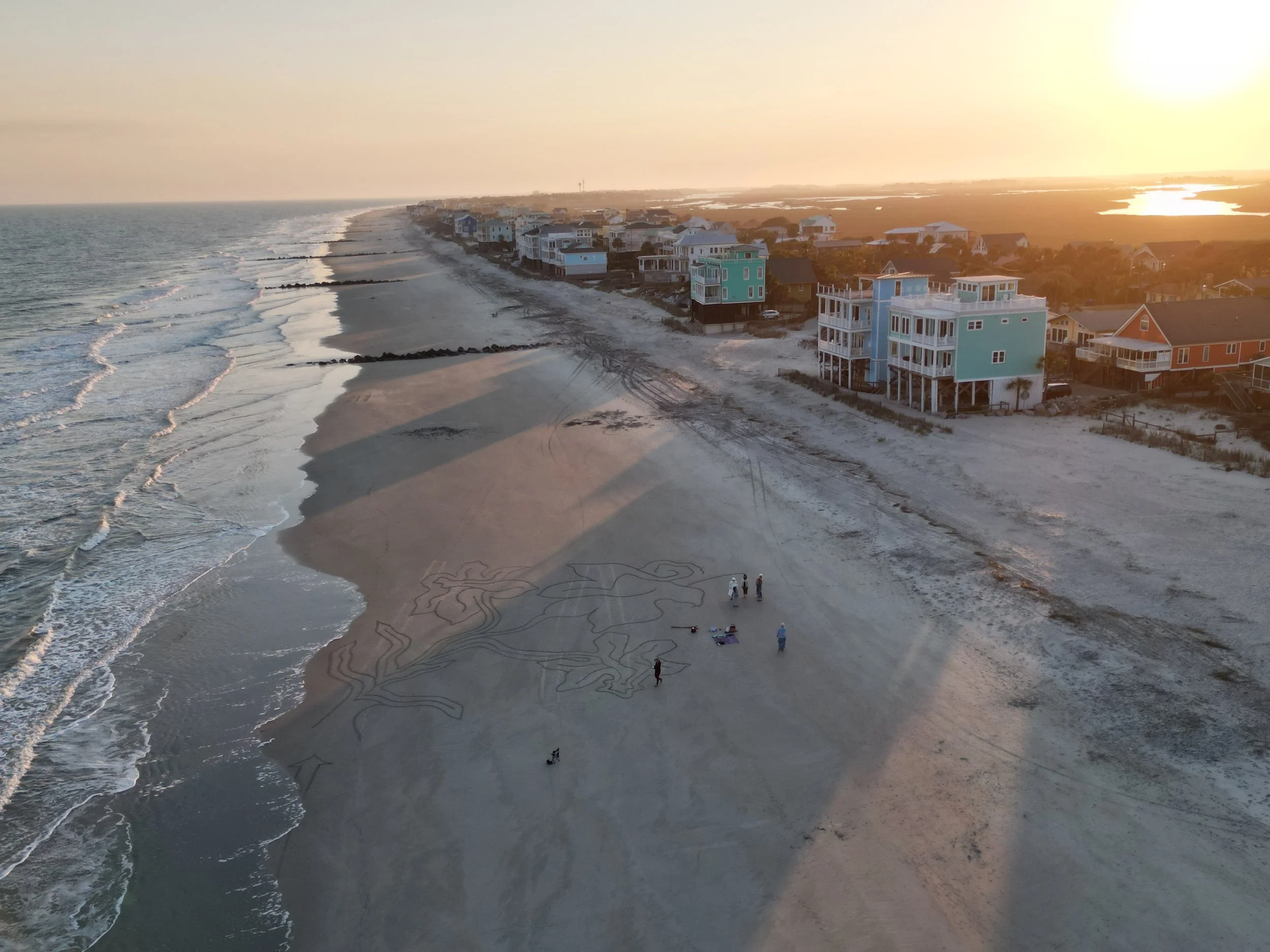
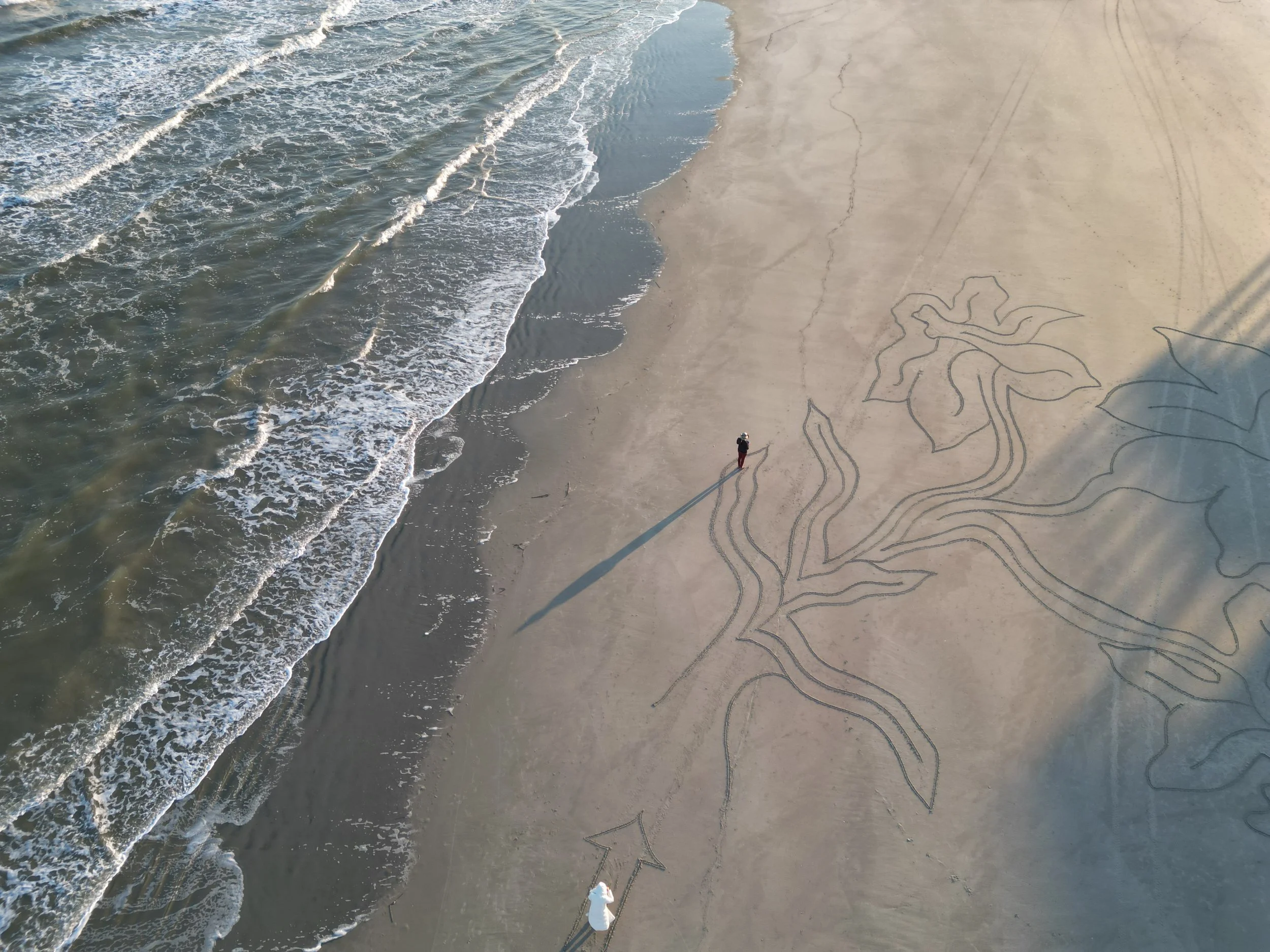
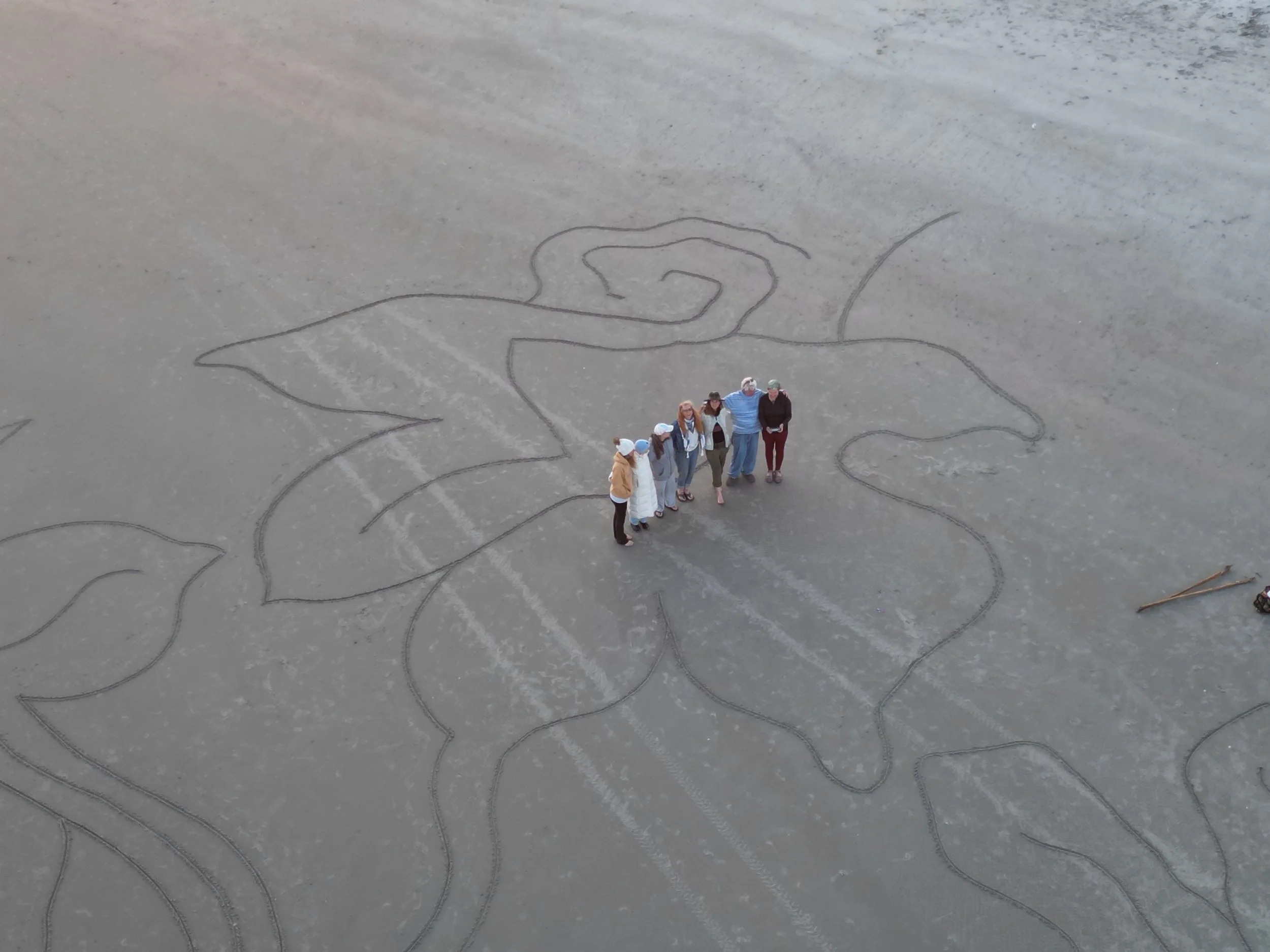
It is a relief to be here with her, to be drawing in the sand and letting the tide erase every line.
This labyrinth feels less like display and more like devotion.
Another short sleep, and I’m back out before dawn for a trial beach run of Snakes and Sanctuaries, immediately regretting I didn’t wake earlier.
The same patch of snakes makes me go nonverbal, scrubbing out curve after curve, unable to get the pattern to connect. Hootie is capturing a timelapse of the dawn, and a crowd of locals are gathering, excited to walk.
I can feel my stress level rise. I like to have a labyrinth done before dawn so that walkers can be in it at sunrise, and I still have four snakes out of nine left to go, plus the boundary. I force myself to pause, look up, and take in the moment, using the 3-2-1 awareness exercise of finding three colors, two sounds, one texture.
It’s the reminder that I’m doing this for me. I get to have the experience of drawing on the beach at sunrise, surrounded by friends, by beauty, and the soothing crash of waves. This trial run is supposed to help me simplify the design. I put my phone with the reference image away. I take a deep breath and tell myself to “make look like snek.”
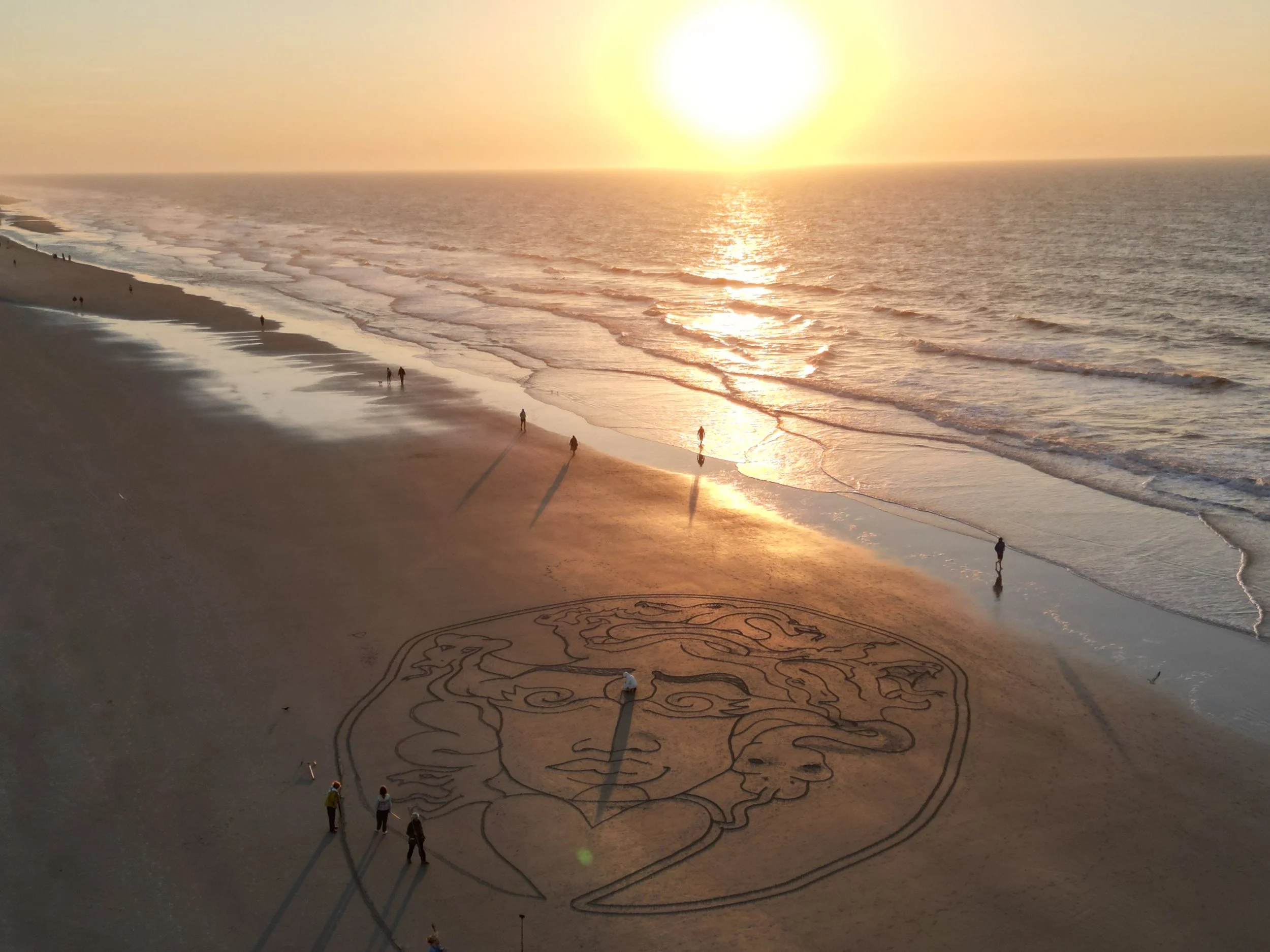
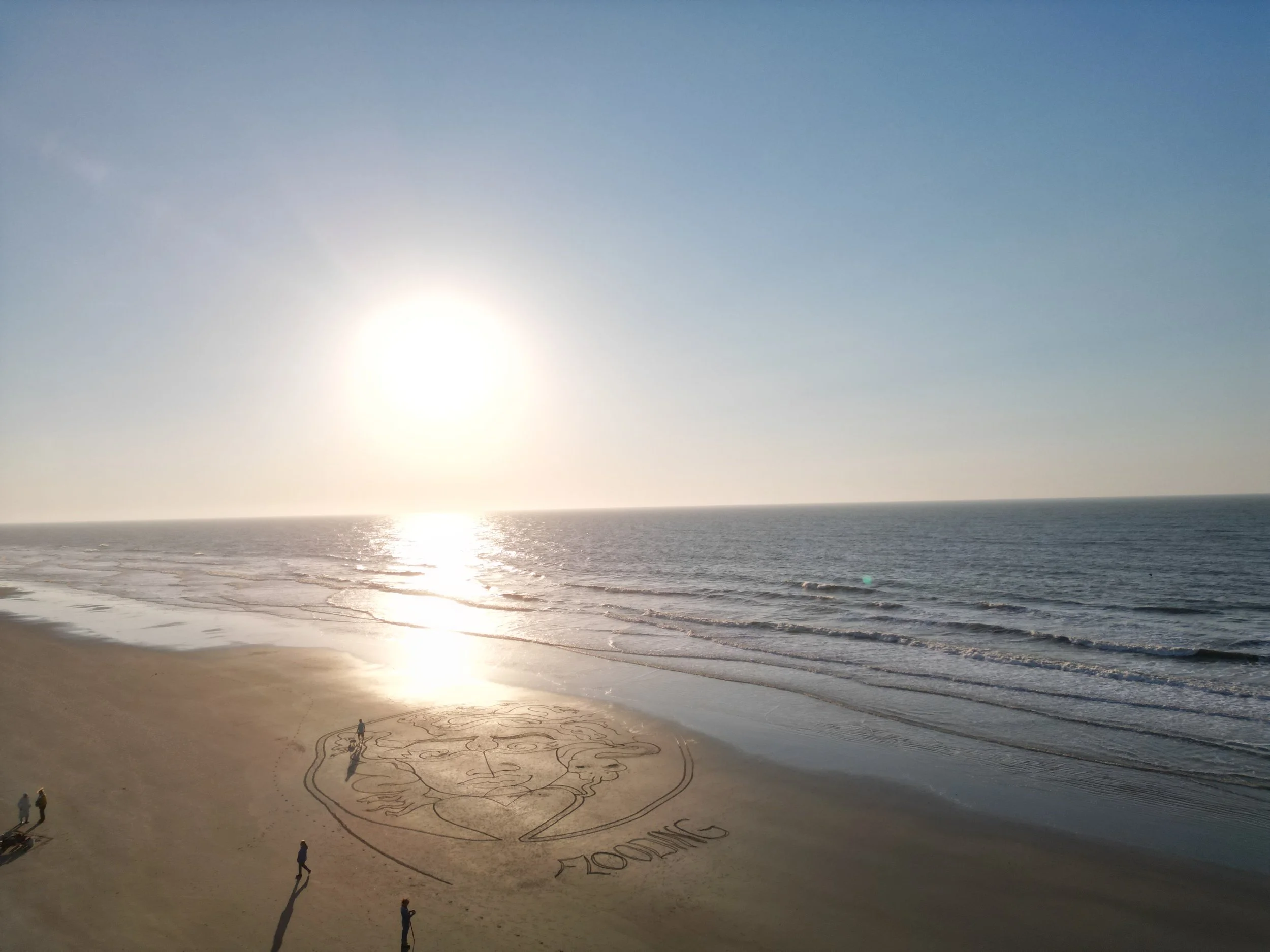
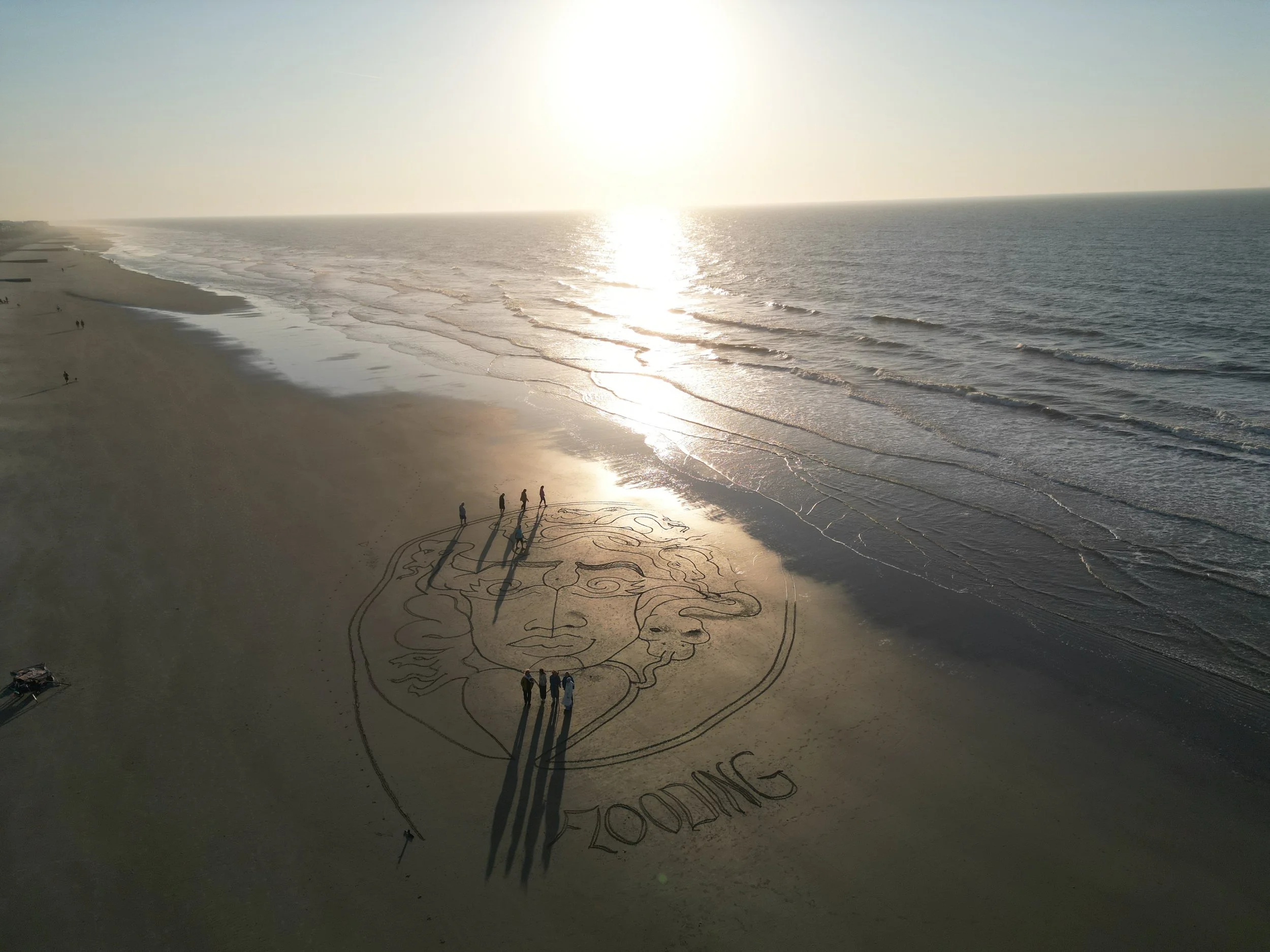
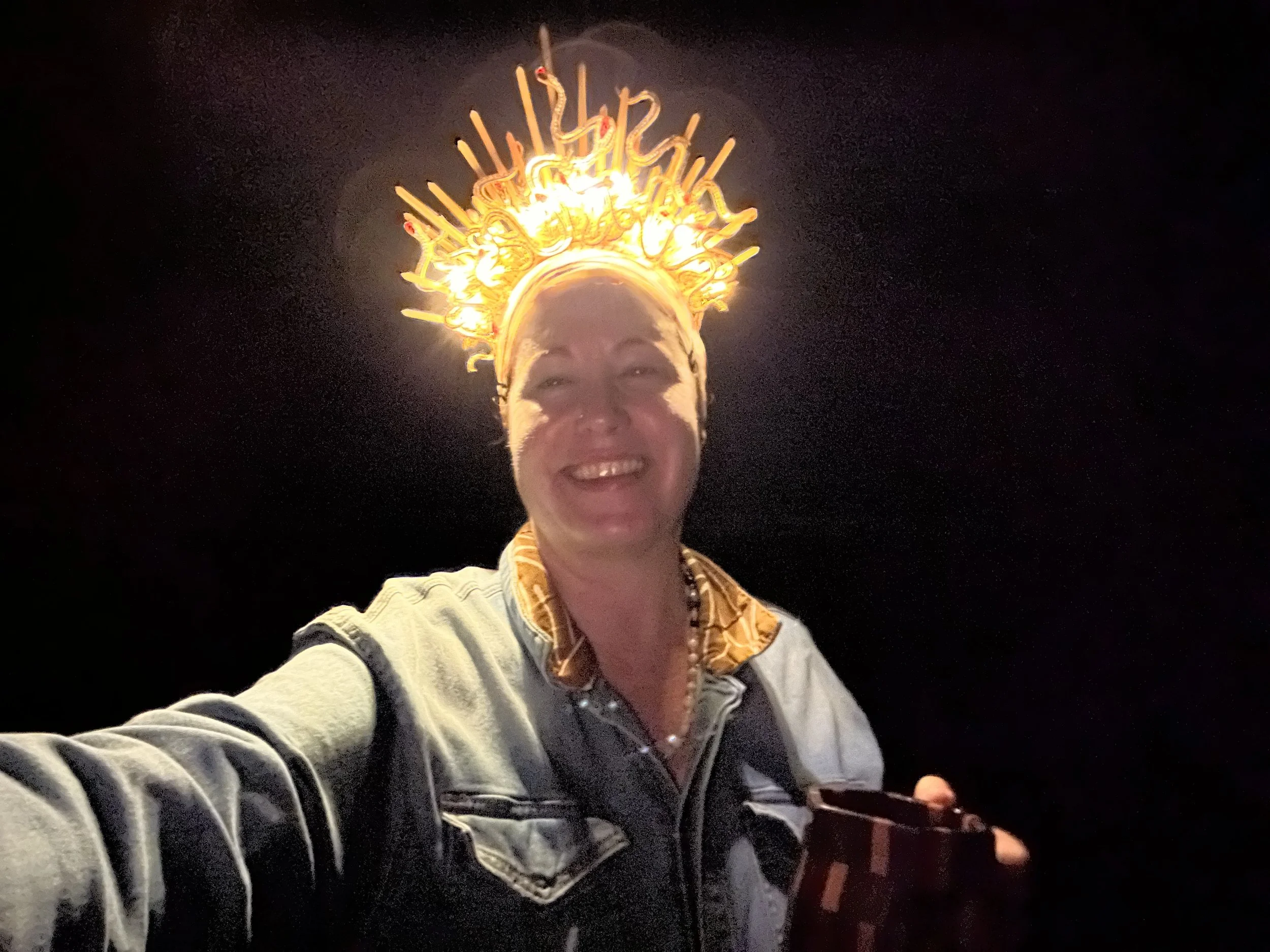
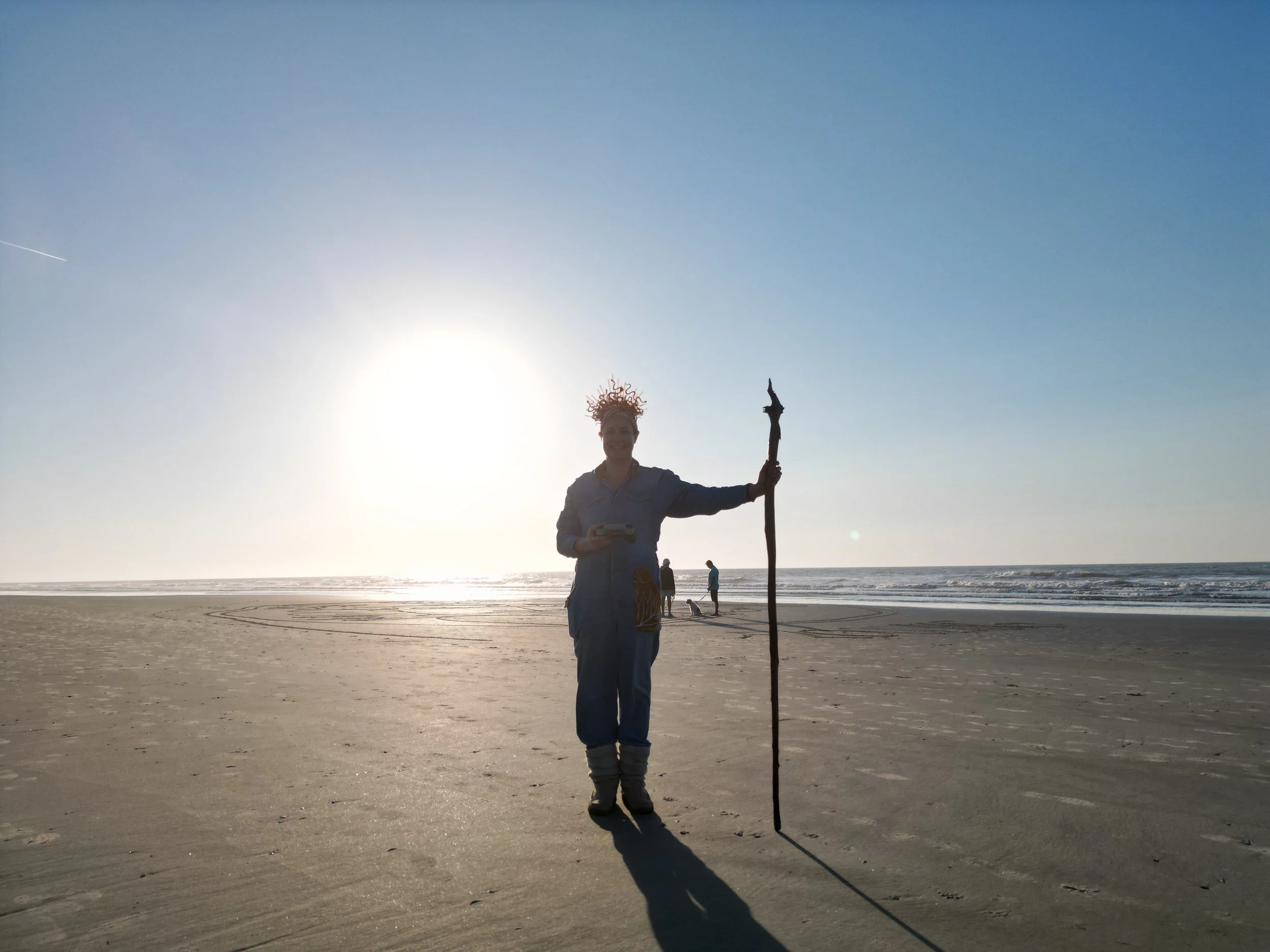
As I’m finishing the outer perimeter, a group approaches to ask what we’re doing. They are intrigued and jump right into Medusa. All except two women who exchange a look, reiterate a promise of a walk to each other, and tell me they’ll catch it on their way back. I glance at the rising tide: “She’ll probably be gone by then.”
And soon, I am the only one left, eating fresh fruit and yogurt before fragments -- one eye, a curve of lip. I cherish these moments when the tide sweeps in. The two women reappear to tell me that they talked about flooding their entire walk. Serendipity’s at play, and they have questions.
“I had a fight with my daughter,” one explains, “She wanted to keep going, but I told her that if we did, I wouldn’t be able to have a productive conversation. Is that flooding?”
“What amazing boundary intelligence,” I exclaim.
My own ability to see a boundary as sacred has matured with my exploration of flooding. I’ve realized I am often ashamed of any need to self-regulate. I can often feel like a failure if I don’t have my shit together at all times.
This brief, intense connection with two strangers on the beach...they never step foot into the labyrinth, but all three of us part with newfound wisdom. Ephemeral art can have an indelible impact.
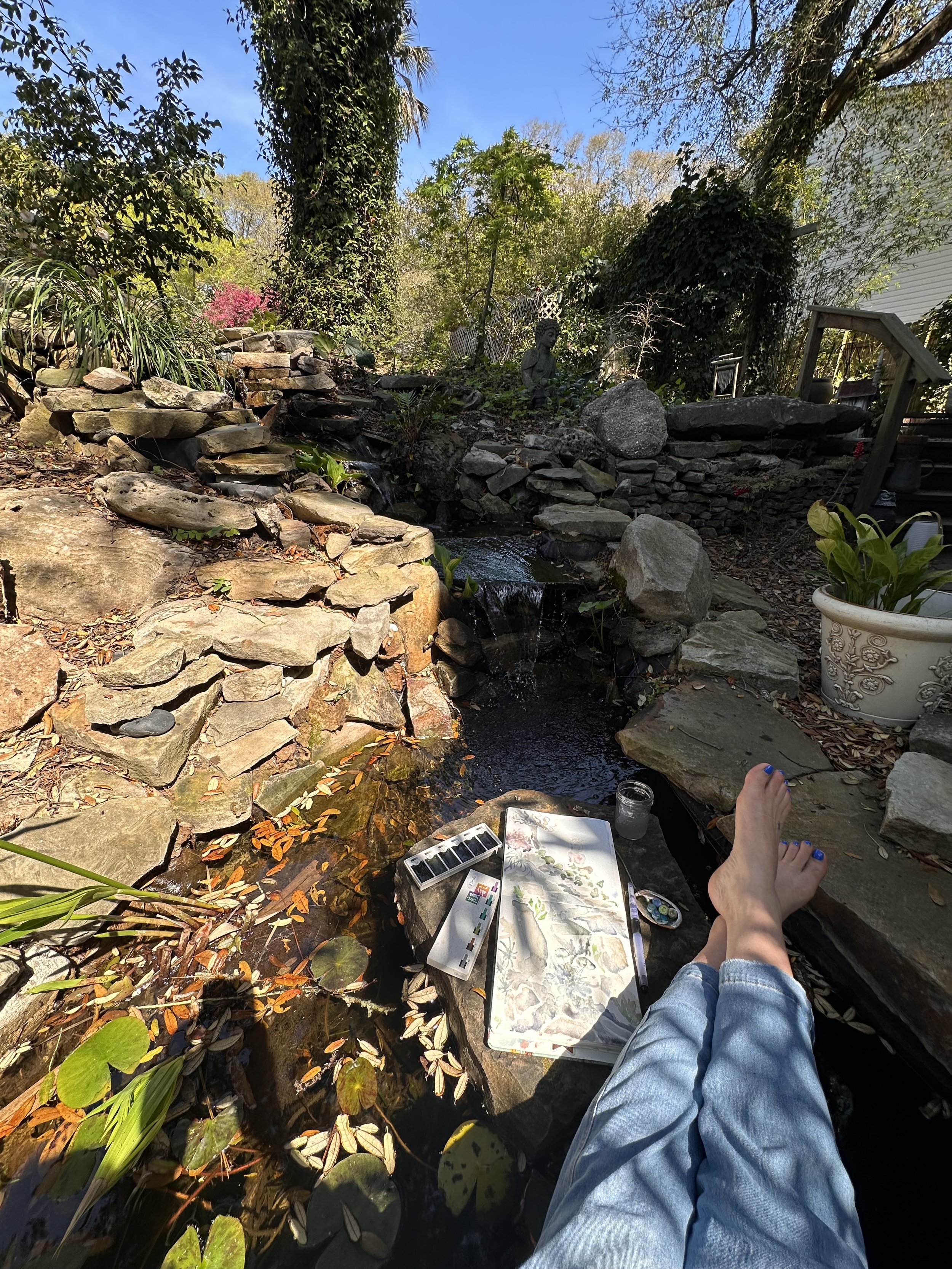
It’s so hard to stay inside for that afternoon’s low tide, but I need to conserve my energy.
I take a meditation walk around Evelyn’s garden instead, break out my watercolors, serenade her with a few rusty songs on my ukulele.
Over dinner, we discuss the day’s build, and I decide to name the snakes. Maybe if I name them, I will struggle less in outlining them.
What are the emotions, the tributaries that most often result in flooding’s confluence? How do they connect?
In the morning, I follow Hootie to the Woodlands, a beautiful oak grove forest an hour away that will be the site of the event. I wrangle my U-Haul into our camp’s designated space just before noon, and the next 18 hours will blur as I throw myself completely into the build.
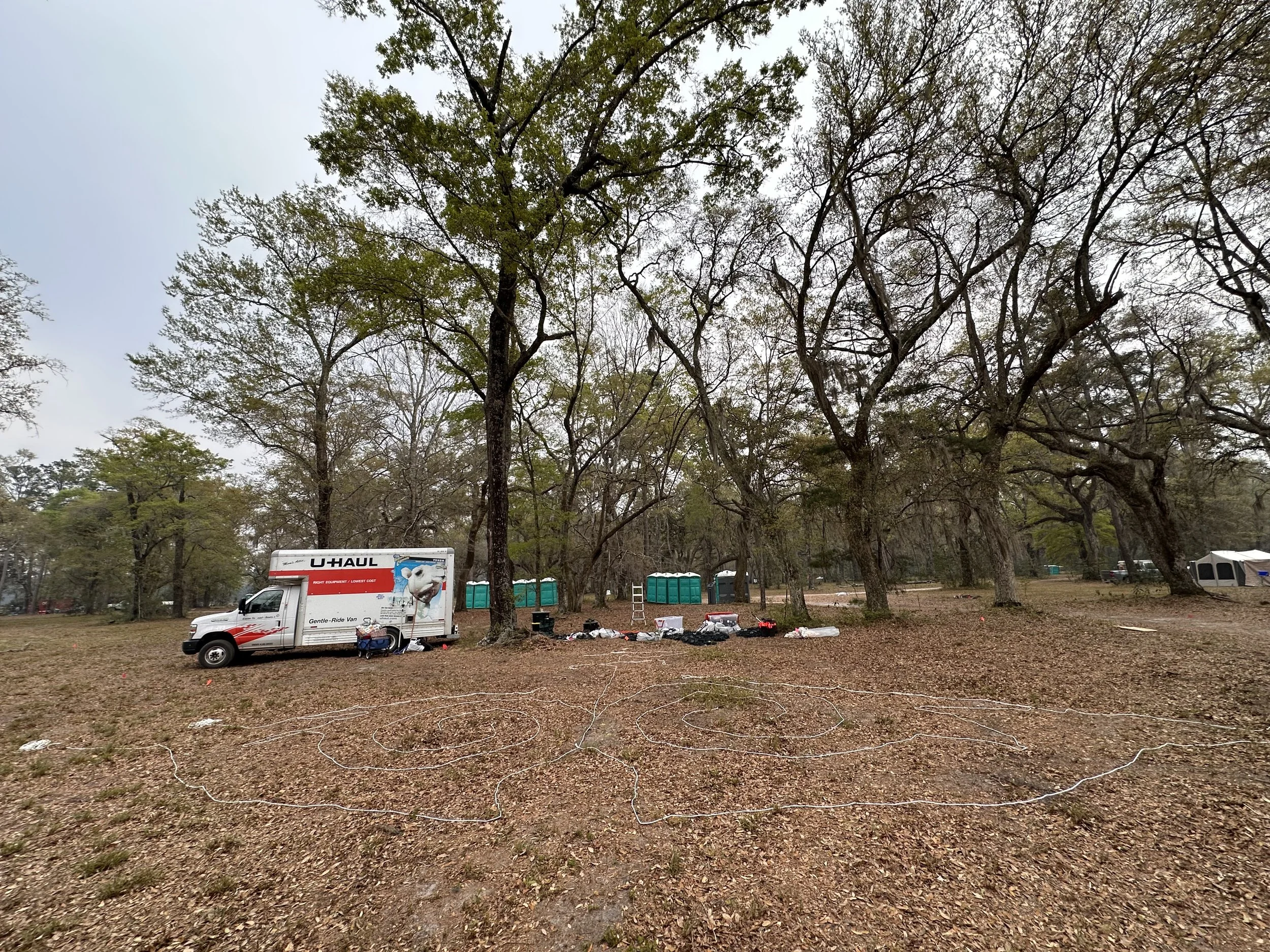
I pace out the footprint, flagging corners and laughing hysterically as I realize how I’ll need to squeeze the pattern from a square into a trapezoid…and around some trees.
Hootie and Journey establish the larger camp boundaries, greeting neighboring camps, piling infrastructure where it will go. I asked for a co-TCO—theme camp organizer—after our last burn, and Journey has been an amazing partner. It’s moments like these, where I am in nonverbal space arguing with rope and perspectives, that her cheerful communication with others makes my eyes brim with gratitude.
Medusa’s eyes come first, and I follow the spirals down her nose to lips, chin, and heart before climbing the ladder to see where the sides of her face and eyebrows will go. The shield’s boundary lines go in. Journey traces the rope with solar LED strands that wink on as the sun sets. Eventually, Journey heads for her tent to unpack; I abandon the rope and work directly with the mesmerizing lights, donning more layers as the temperature plummets.
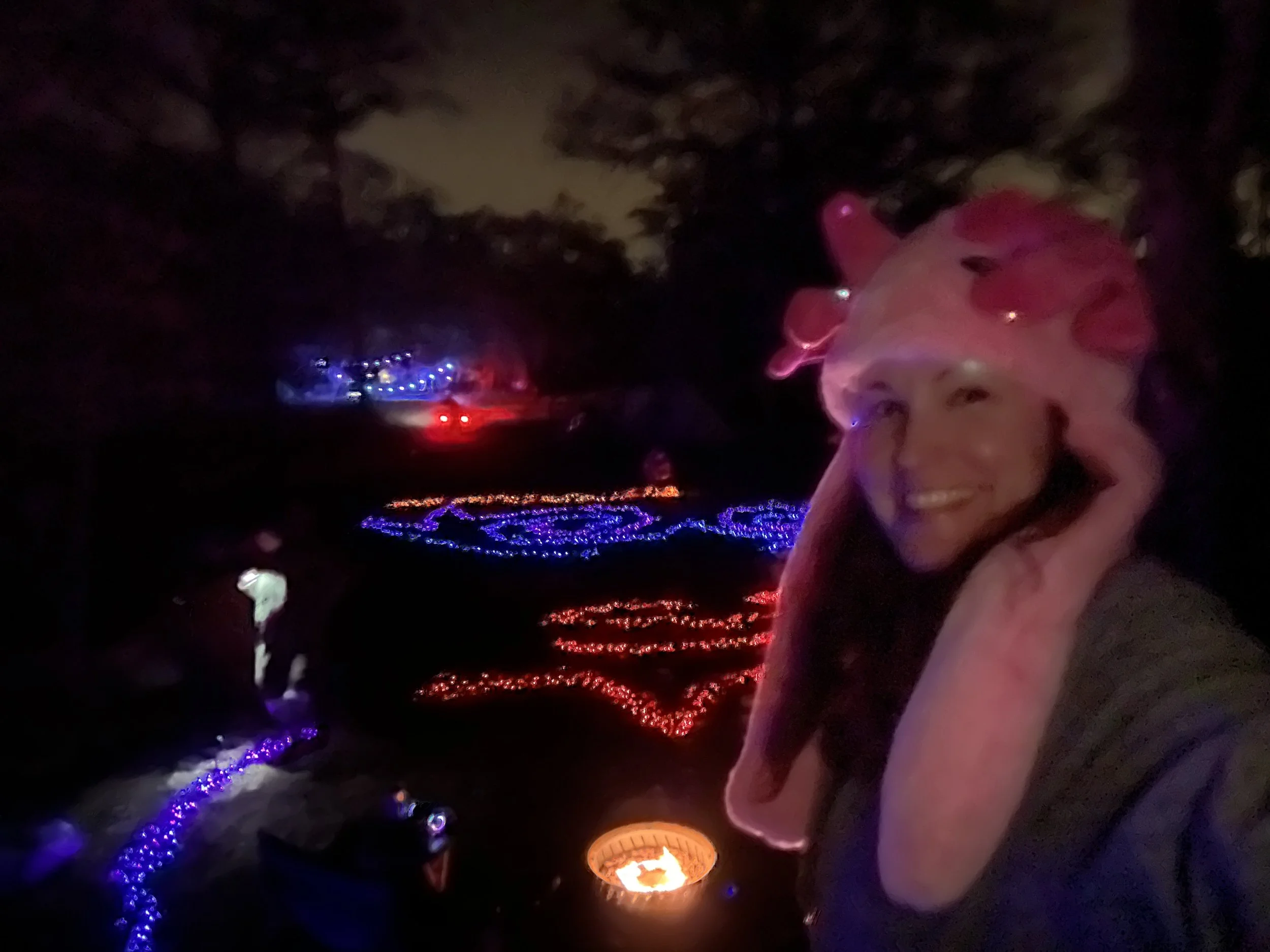
This is my sanctuary, and now it’s time for some snakes.
I boost a playlist in my pocket and set a fire for warmth. Instead of beginning in the bottom right corner and working counter-clockwise, I start in the bottom left and go the opposite direction.
As counter-intuitive as the pattern’s flow makes this feel, naming my snakes has revealed some internal coherence I think about. They’re not just feelings, but the behaviors that announce them.
I join Defensiveness to Humiliation’s abashed expression. Shame and Blame connect through two curling tongues, with Blame backing up into Betrayal. Hurt trickles into Rage, and here’s the part that gets twisty: Helplessness is bisected, with one half of the snake linking Rage to Fear and the other creating a loop from Medusa’s forehead to her eye.
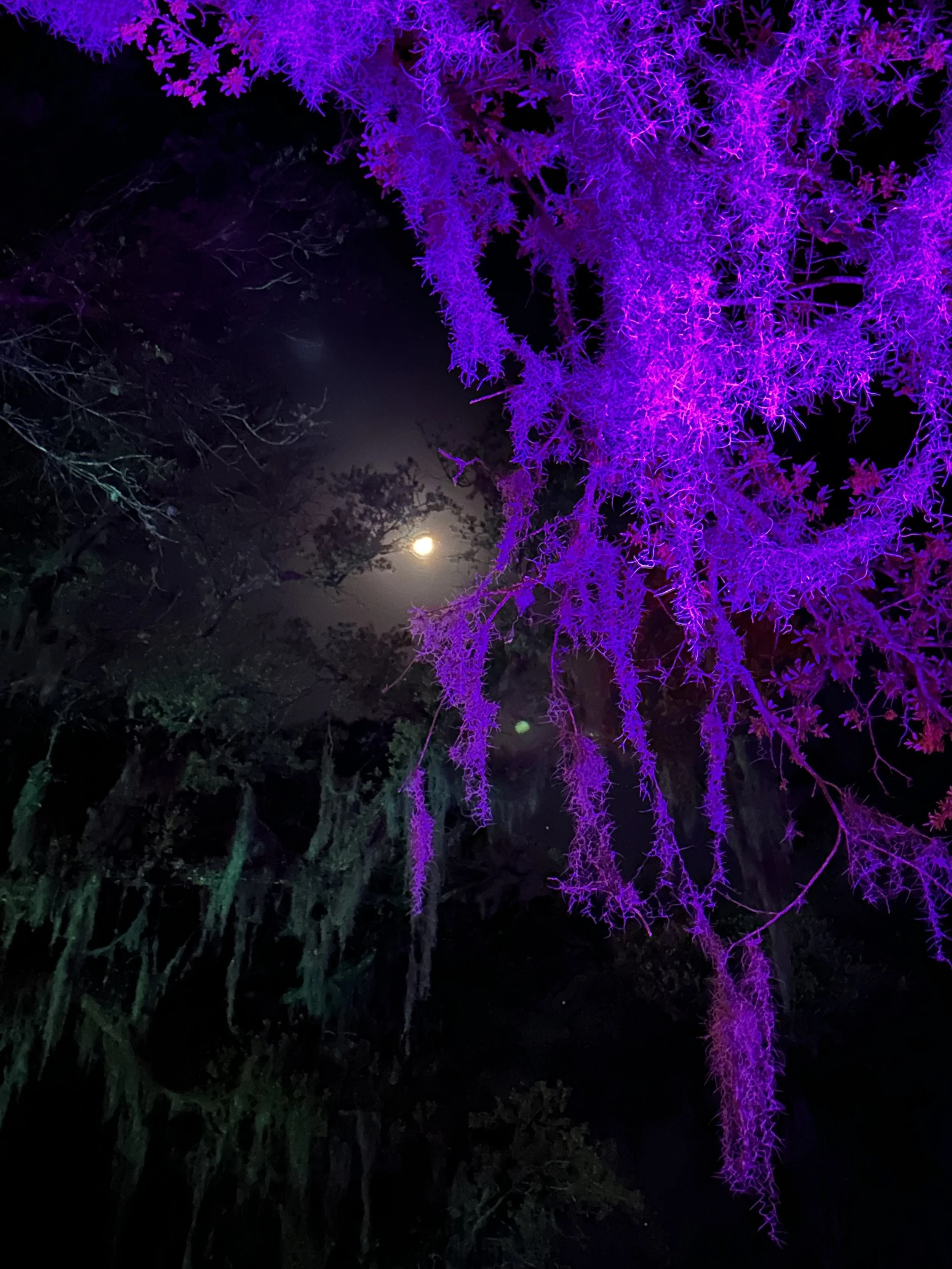
The moon rises just when I need another jolt of energy, a witness to me connecting behavior to backstory, biography to biology.
I find myself thinking about the fire performer’s mantra “safety third,” meaning that if something goes awry during a performance, one should care for the audience first, venue second, and stupid person playing with fire third. However, when I am flooded, I MUST address my own safety first. Do not pass go; do not collect $200. I cannot address other factors until I feel safe, even within the flimsiest of containers.
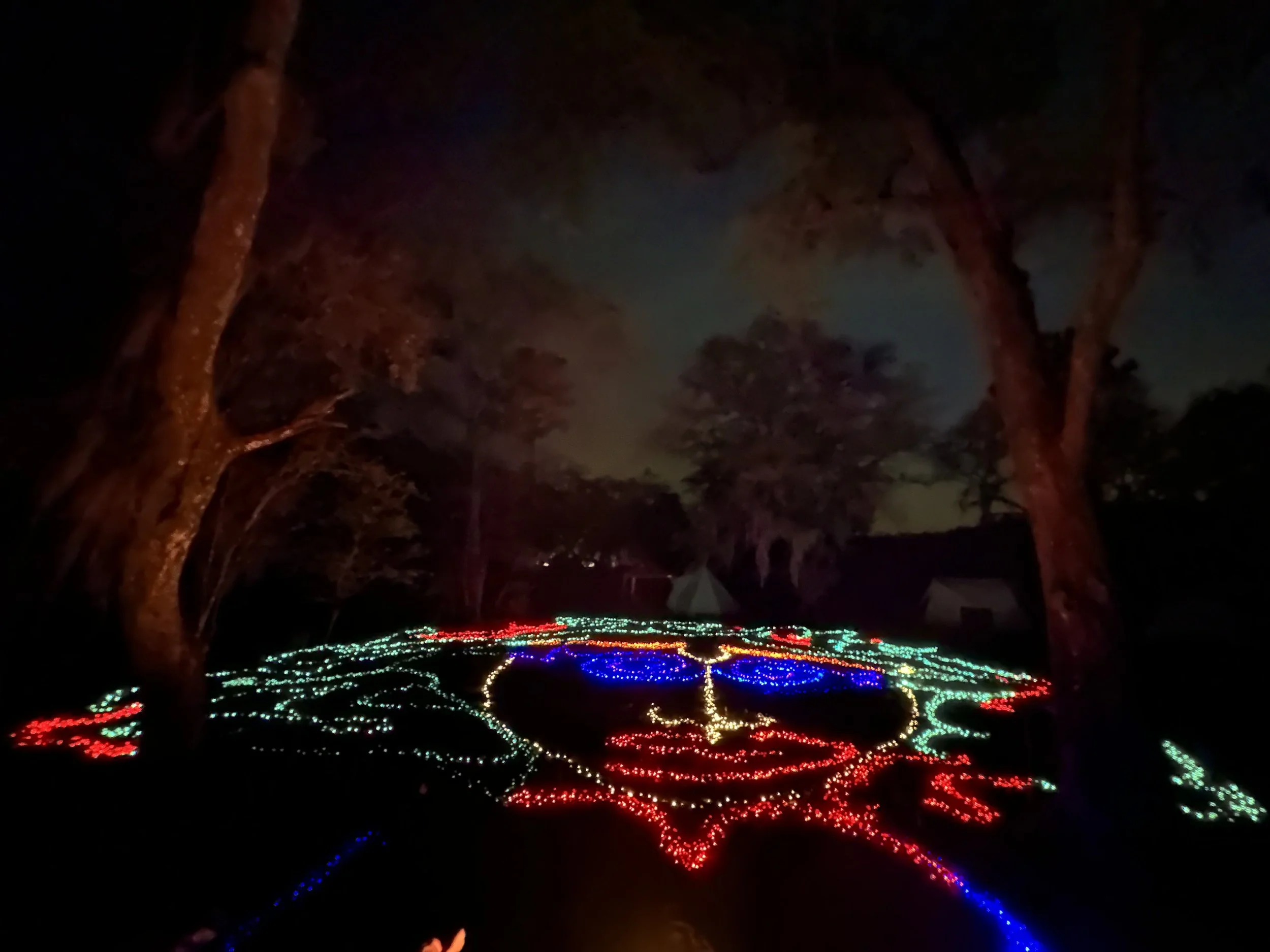
With a single strand outline in place, I climb the ladder one more time to trace it with my eyes and send my campmates a snap.
It’s just after 4 AM, and I’ll spend the next two hours on personal infrastructure, or as I tend to call it: unfucking my tent.
A quest for clean socks and Biofreeze turns into a full settling in. This is the maiden voyage of our new Shiftpod, and it’s spectacular to hang costumes on an actual rack while munching jerky as a heating pad warms my sleeping bag.
I crash out, HARD. It’s after 10 AM when I wake, and Journey has been tripling LED strands for hours, thickening in my outline. Wizard bounces in and out of camp; he’s been onsite for days, working on the effigy build, and he’s excited about creating a gallery of his embroidery pieces alongside the truck. Hootie is setting up her Owl’s Nest for bodywork.
Today is for details—stanchions, mirrors, “ceiling doilies”, spotlights, snake eyes, fangs, staking the pattern, setting out elemental stations, building the camp chill space—before the energy shifts tomorrow as campmates arrive and the burn swings up into high gear. Everywhere, I find gifts and reminders from my past self for my current self, right down to a sharpied reminder on a ramen packet: “You can do this!”
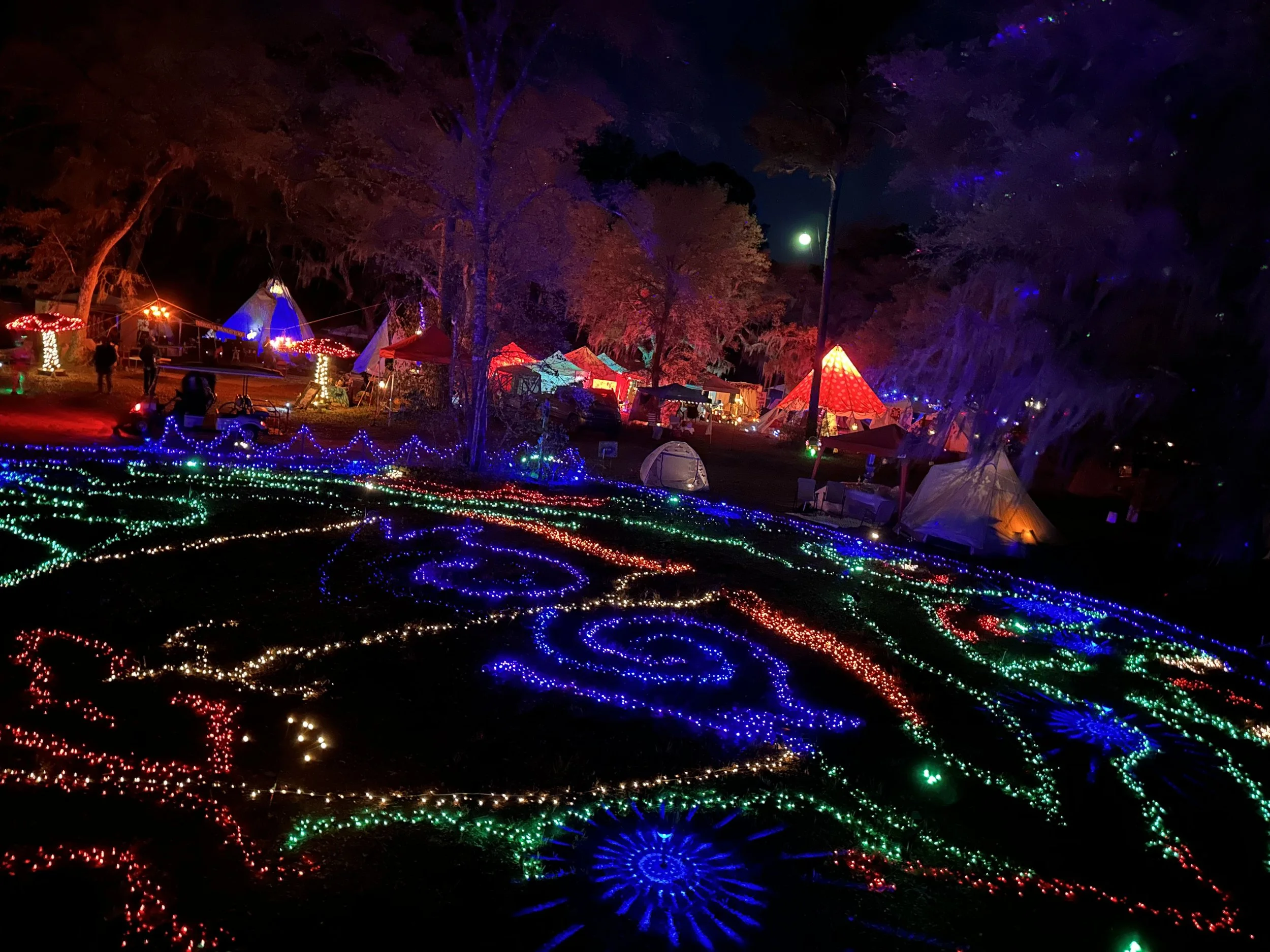
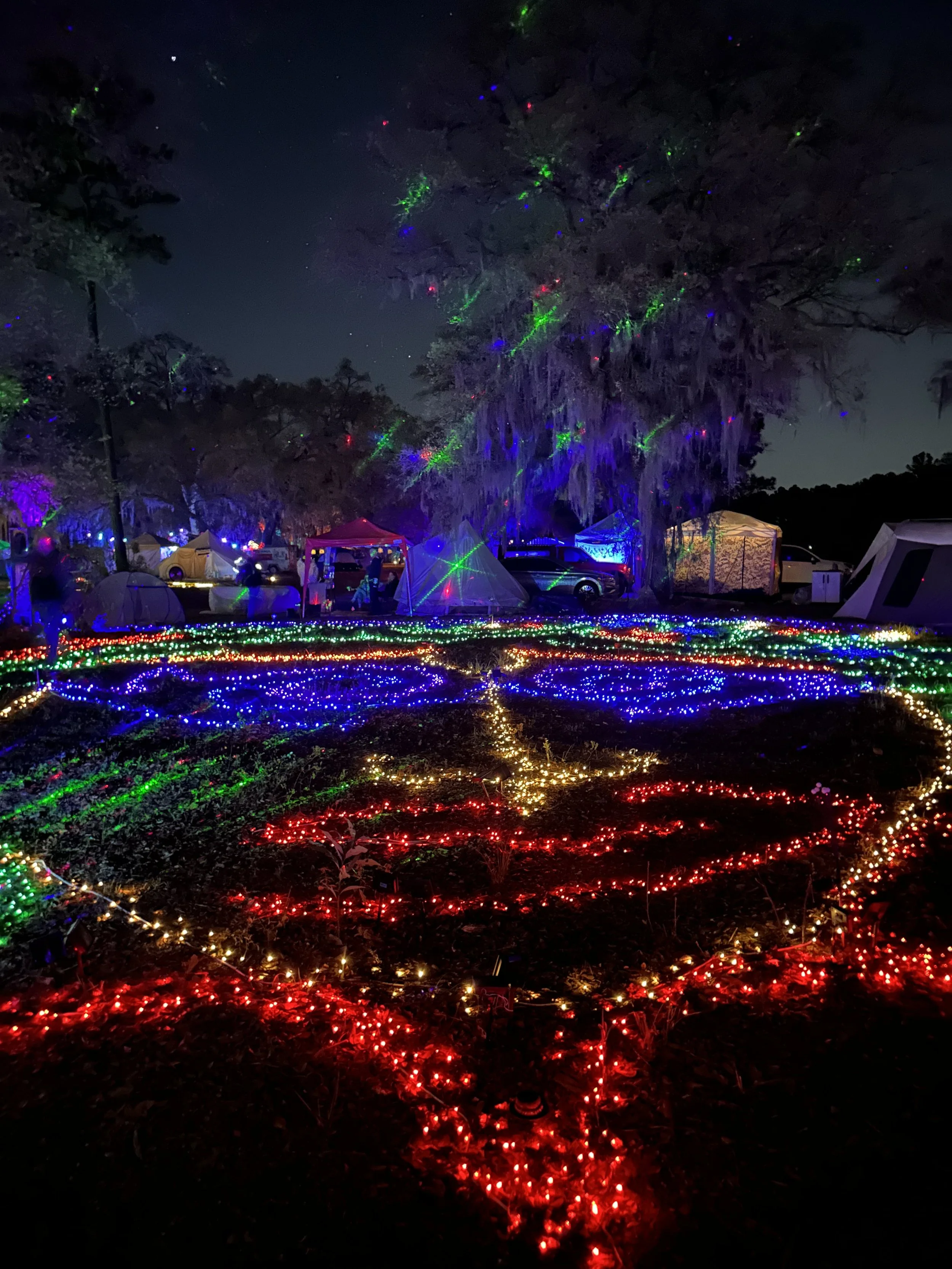
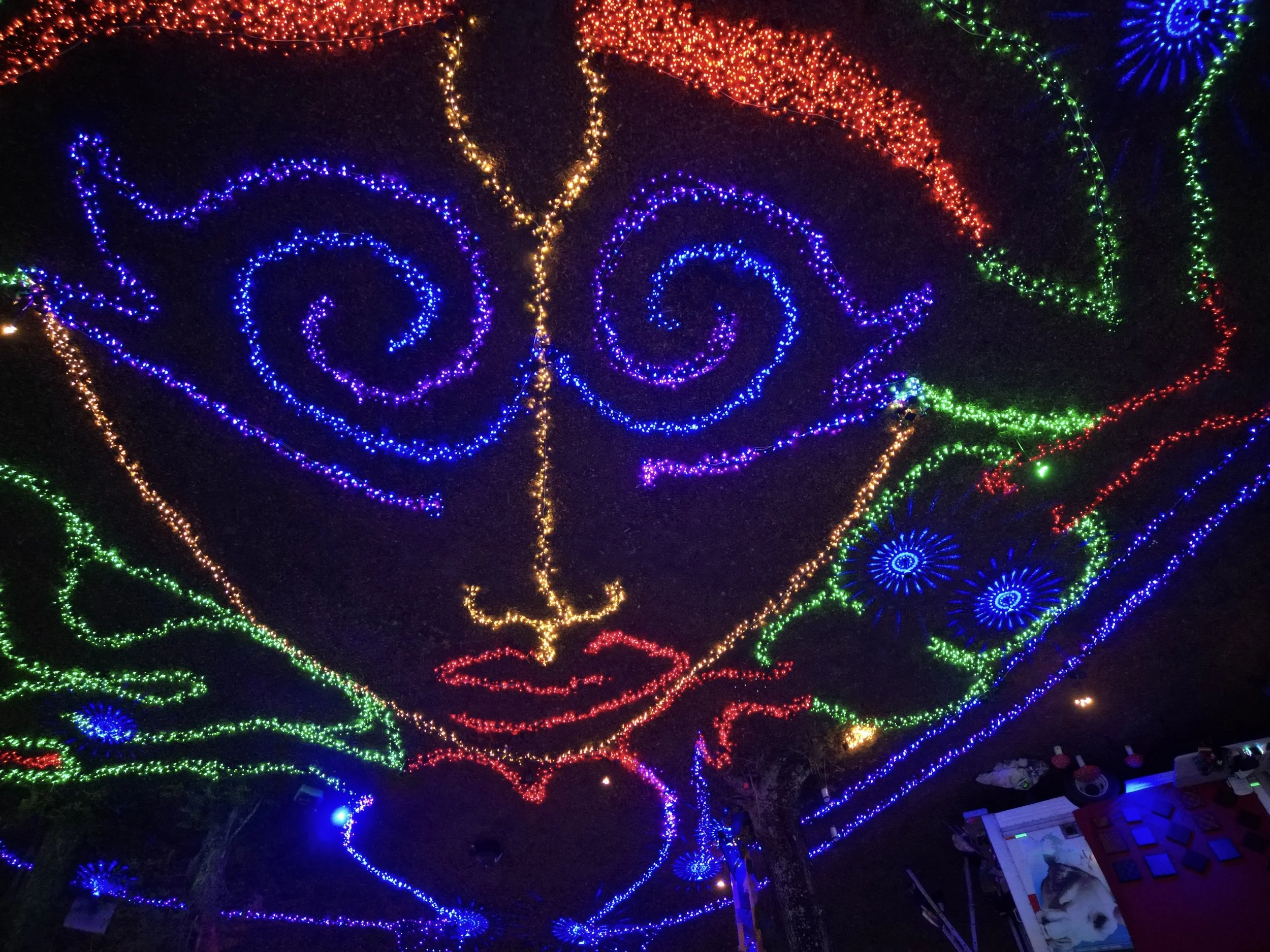
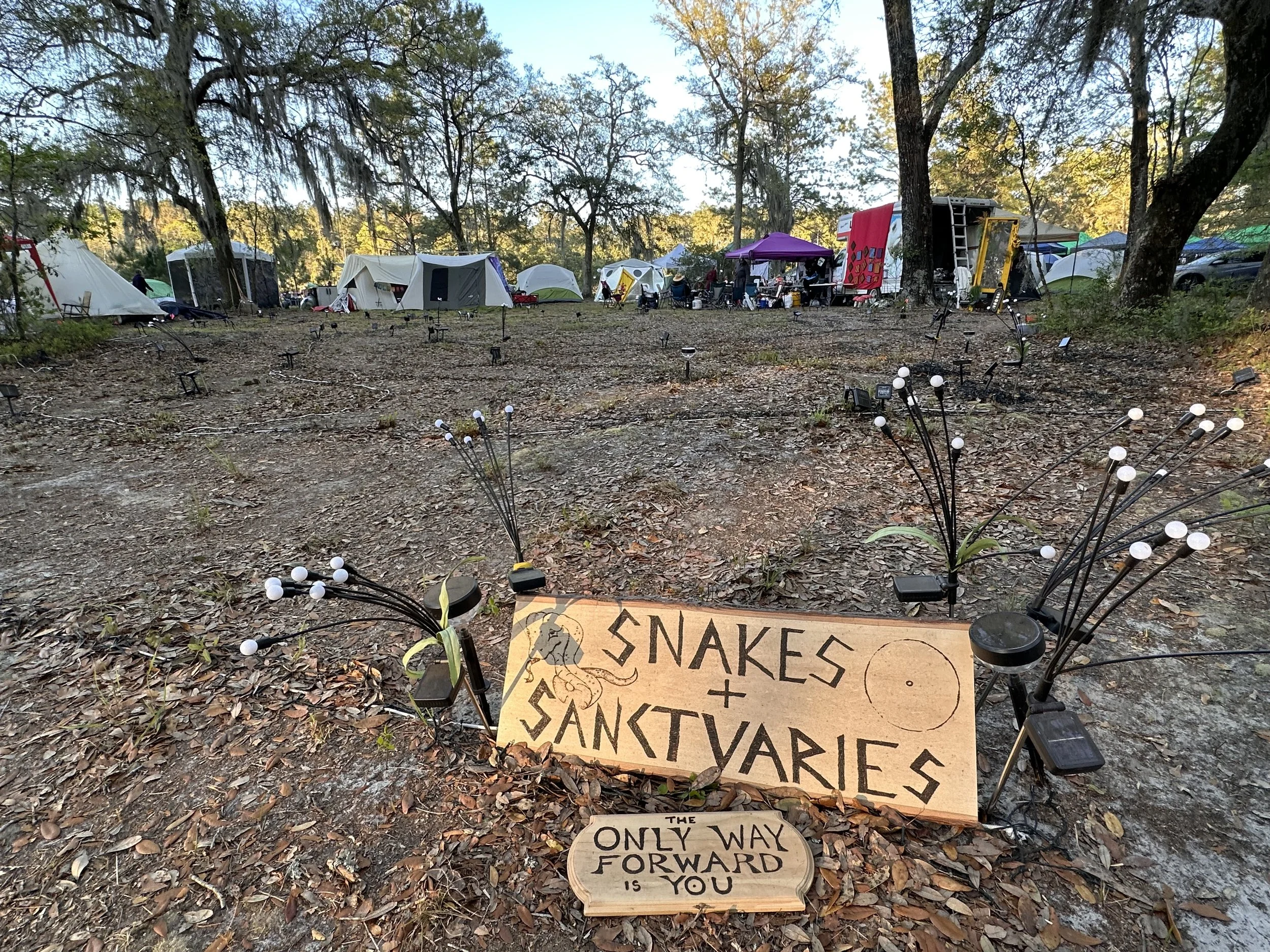
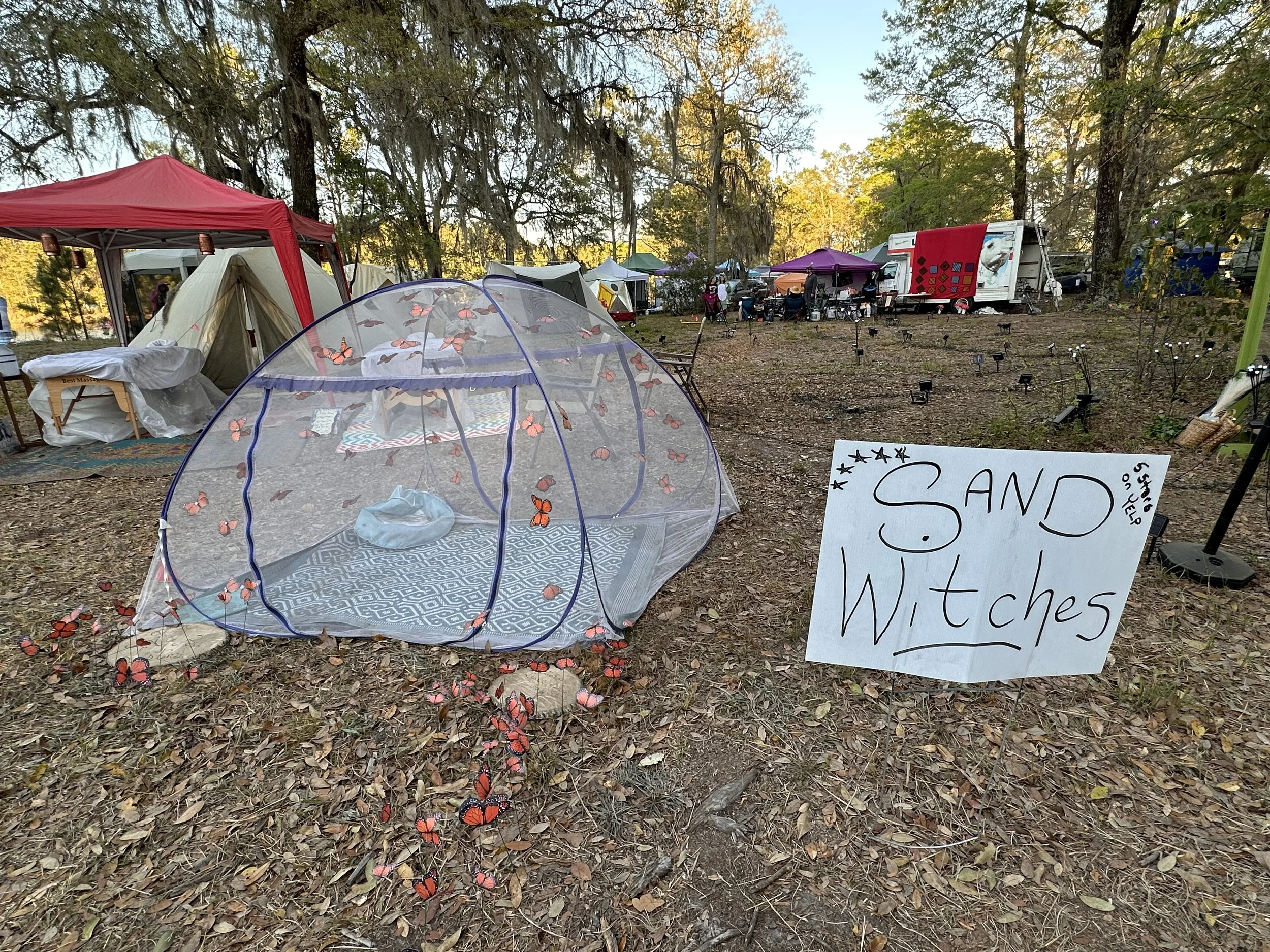
Beyond the planning, however, the best parts of the burn aren’t things I schedule, but what happens when I let the burn come to me. Making music in the front of camp with my husband when Shany arrives with chorizo tacos and a total stranger brings us fresh baked cookies and two whole pizzas. Discovering my neighbor’s daughter has adopted the Air Pod and decorated it with butterflies on her own. Dancing through the labyrinth at magic hour with April, Brandy, Hootie, and Rex. Breaking out my watercolors. “Hippie fishing” off the front of camp early in the wee hours with a blinkie ring lure on a fishing pole.
One person who falls for the lure laughs and says we have to fall into his hippie trap, and so Kaz, Cyn, and I find ourselves part of a secret puppet show. Kaz improvises a completely bizarre tale of underwater horses who find themselves in Philadelphia, and the whole audience is in stitches. I am gifted my own puppet, a fluffy alter-ego I name Peaches.
I love my camp so much, welcoming each member into the labyrinth with a bendy snake and the words: “Welcome to Camp SandWitches. Thank you for doing this with me. Here is your snek.” When I wake Sunday morning, the rest of camp is already most of the way through striking the pattern, a kindness that reduces me to tears I blame on the massive pollen drop.
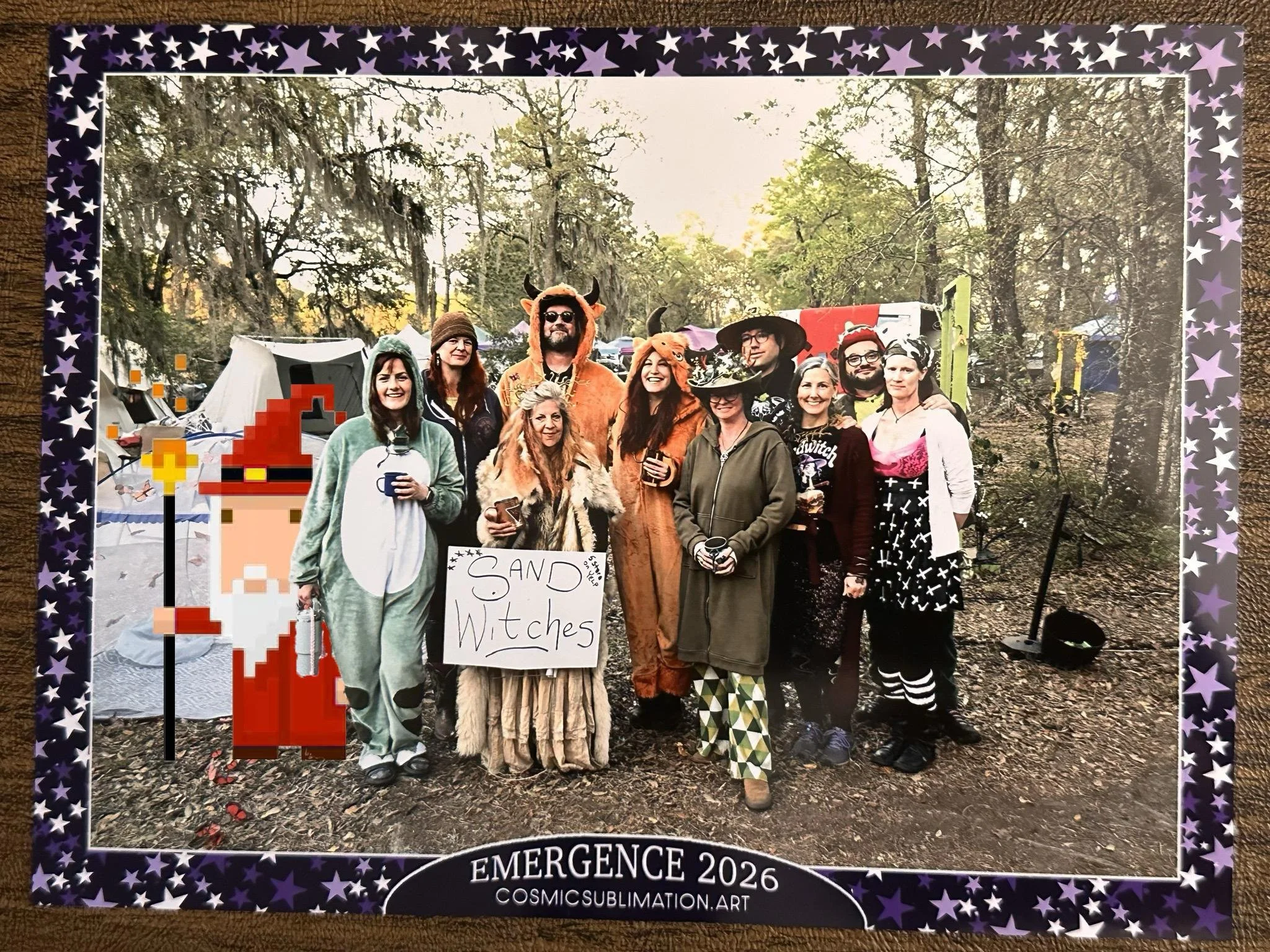
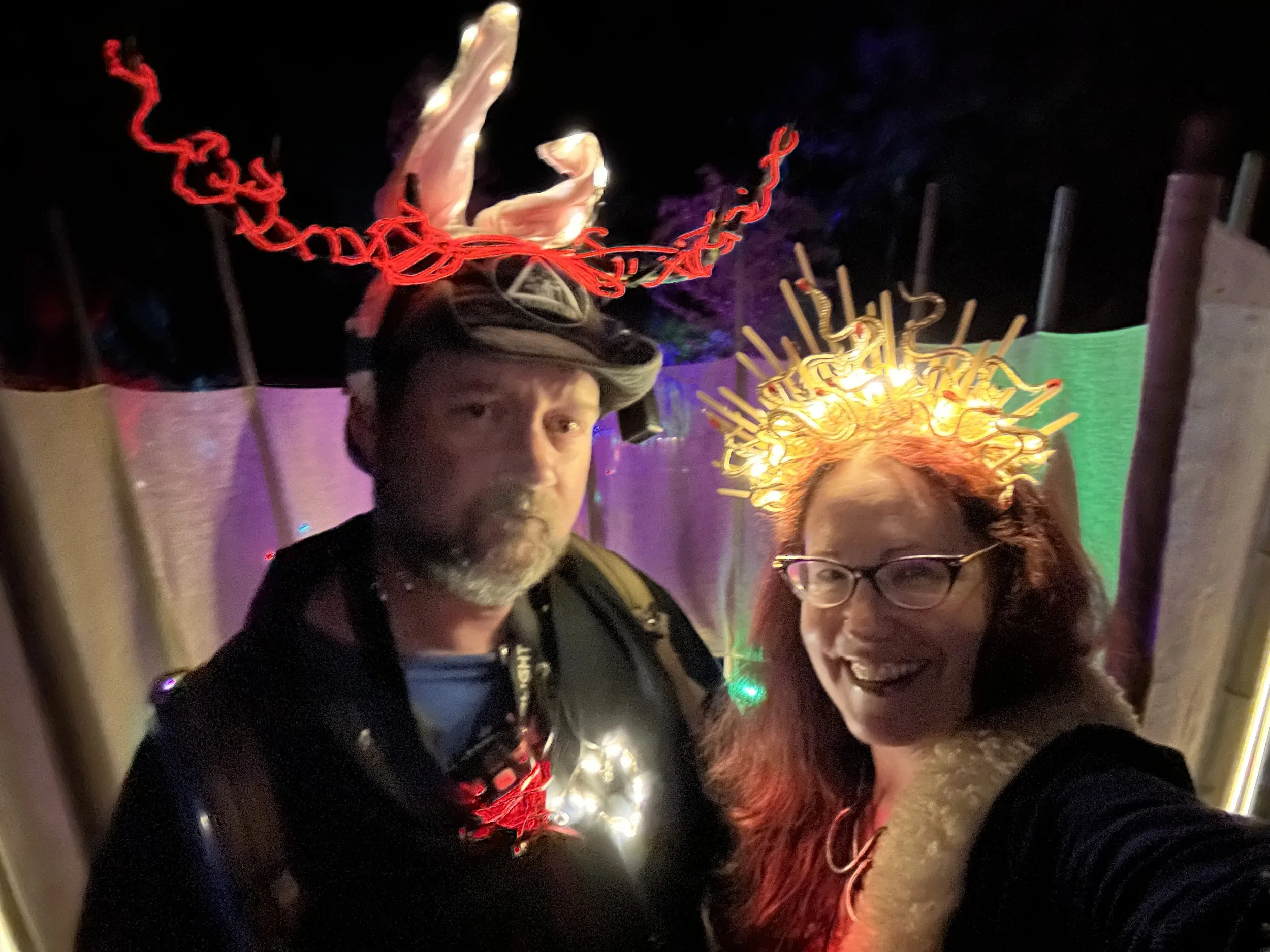
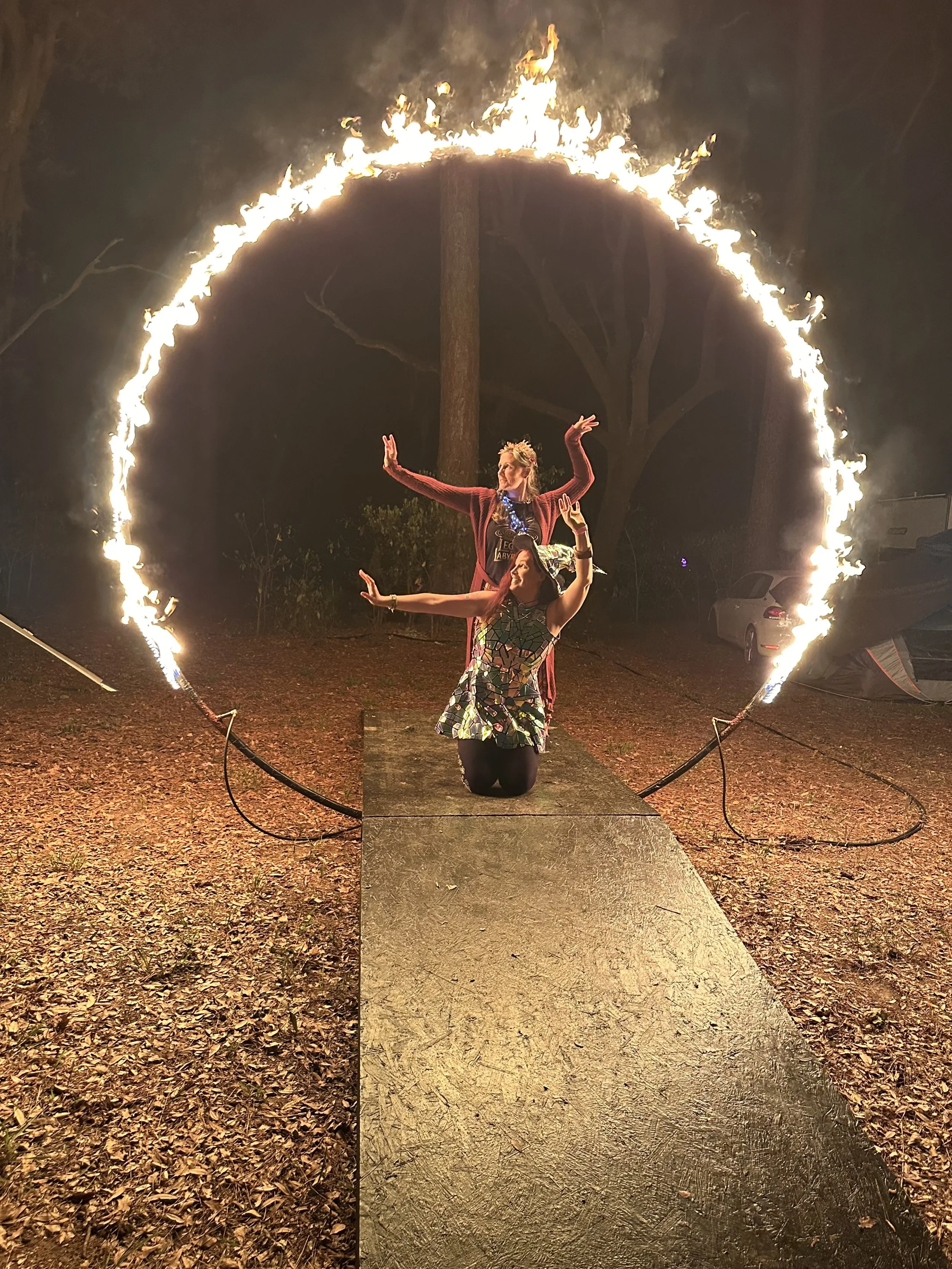
Throughout the event, I collect tales of flooding from participants and field so many questions. I wind up not running my yoga flow on the last day—I eat and paint instead—but I recommend it to so many people as a capture of my coping mechanisms that I’m re-sharing it here. I practice with it once I get home as part of my post-burn decompression, where I try to make sense of this experience.
The beach builds were ephemeral, tide-bound, and relational. They placed me in direct conversation with time, intuition, impermanence, and care, especially in connection with my friend‘s recovery.
The Emergence build was an ordeal-plus-offering. I wrestled with materials, space, temperature, pollen, sleep, food, and timing on top of the emotional architecture of the piece itself. I navigated my own experiences with fear, helplessness, rage, hurt, betrayal, shame, blame, humiliation, and defensiveness. But the meaning was not only in what I made, but in how the event kept answering me through other people, improvisation, humor, music, conversation, and elaboration.
The most powerful exchanges are with burners who tell me not only about flooding in their own timelines, but about how many of my other labyrinths they have walked. Multiple people tell me that the encounters they’ve had with my work have shifted their self-awareness and even the way they self-identify. That what they’ve learned has positively shifted the trajectory of their lives since.
I widen my stance when this happens, bending my knees and opening my palms to receive their words.
Like the two women on the beach whose self-awareness shifted without ever walking it, this work isn’t just the labyrinth. It’s what happens in the body. The bit of space that remains even when the catalyst is gone, the reorganization as integration takes place.
And in closing, here are some truths I’m integrating:
Boundaries protect what is sacred, and boundary intelligence shifts them from punitive to relational
Regulation must come before interpretation, and my real emergency is often not the external situation but my internal, unregulated state that requires me to reverse “safety third” logic
The secondary wound of shame and humiliation for “not having my shit together” or in damaging relationships when I flood may be more destabilizing than the flood’s actual trigger
The art I’m drawn to creating right now is regulation technology, a functional field lab for emotional pattern recognition
Softening perfection into collaboration doesn’t lose meaning; it’s artistic delegation and emotional honesty, developing rotating leadership that doesn't pretend one person must be endlessly available
Impermanence can concentrate meaning
The richest moments often arrive spontaneously and sideways: Strive to remain open
To Camp SandWitches and everyone who engaged with these pieces: Thank you for doing this with me.
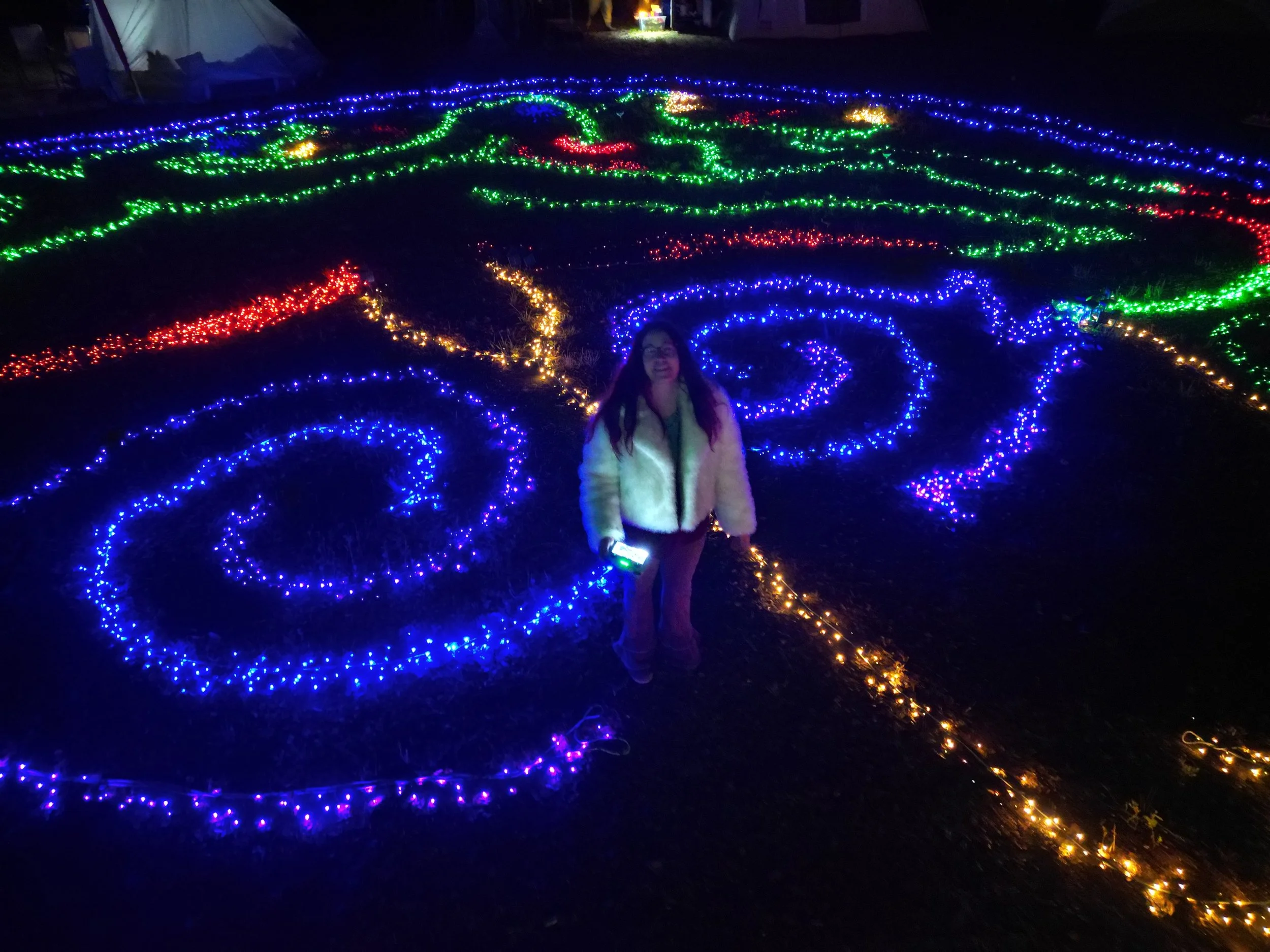
Snakes and Sanctuaries
Emergence | March 26-30, 2026 | Near Charleston, SC
The SandWitches invite you to step into a story older than language and as immediate as the body’s own tremor — the story of flooding, that sudden inward collapse when the self becomes unreachable even to itself. Here, Medusa gazes into her earliest form: not a terror, but a woman transfigured by violation and misremembered by history. Her serpents curl into pathways; her stare softens into metaphor; her heart waits in a chamber made of light. As you walk her winding lengths, you wander inside the moment a boundary is broken, the instant the inner temple is overrun and the breath petrifies in the throat. This is the geography of the shutdown, the quiet terrain where the protector-self rises too swiftly, too fiercely, too completely.
Two passages lead inward and outward, each tracing its own retelling of the same truth: that every heart holds a storm, and every storm holds a heart worth returning to. One path brings you directly to the still, frozen center before guiding you toward the edges again; the other approaches the center only after circling the periphery with caution and care. Both ask the same question in different accents: How does one move from reaction toward response, from petrification toward presence, from mythic danger toward human tenderness?
In this illuminated retelling, the Gorgon is not a monster to defeat but a guardian to understand. She’s the embodied reminder that the heart sometimes turns to stone only to survive the moment that demanded too much. Walking this labyrinth is an act of re-membering: that the body is wise, that the pause has a purpose, and that the path back to the sanctuary of oneself is ancient, winding, and worth the journey.
This labyrinth pattern is one of 87 created by the artist Charms to process each of the emotions and experiences in Brené Brown’s “Atlas of the Heart.” You may have walked solar LED installations from this same series at other events: “Spiral Beyond Shame” during Alchemy 2024, “Resign to Rise” at Emergence 2025, or “This Be-Longing” at Alchemy 2025.